
The fall 2025 showcase included semester-long design projects from more than 600 students across engineering, design, and computing.
(text and background only visible when logged in)

Team Bladder Buddies was the overall winner of the 2025 Fall Capstone Design Expo.
(text and background only visible when logged in)
Projects stretching around the Capstone Design Expo Dec. 1 addressed medical needs, found ways for nonprofits to improve their operations, and designed safer roads. They also delivered for the imagination, including futuristic aircraft designs and robots for all kinds of uses.
But top honors at the Fall 2025 edition of the expo went to a wearable device to help older people and those with spinal cord injuries know when their bladder is full. Roughly 22 million Americans suffer from impaired nerve function and can’t feel when it’s time to use the bathroom, a condition that can lead to complications such as urinary tract infections and kidney damage.
“For patients who are struggling with incontinence, and older people who have more issues with bladder control, it can really become a matter of dignity and security and confidence in how they live their lives,” said biomedical engineering student Samyukta Iyer.
The team’s device is noninvasive, has an all-day battery, and can be clipped on a belt or tucked in a pocket. It alerts users with a small light or a push notification on a smartphone.
The team of electrical, computer, and biomedical engineering students was one of 118 groups at the fall expo, a showcase of design projects from more than 620 students studying engineering, industrial design, and computer science.
In addition to the best overall project, judges recognized the top team from each engineering school and the best interdisciplinary project.
(text and background only visible when logged in)
See More Photos
A look at more projects and teams from the fall Expo.
(text and background only visible when logged in)

IncontiSense is a smart wearable device that non-invasively monitors bladder volume to prevent health complications for individuals with neurogenic lower urinary tract dysfunction.

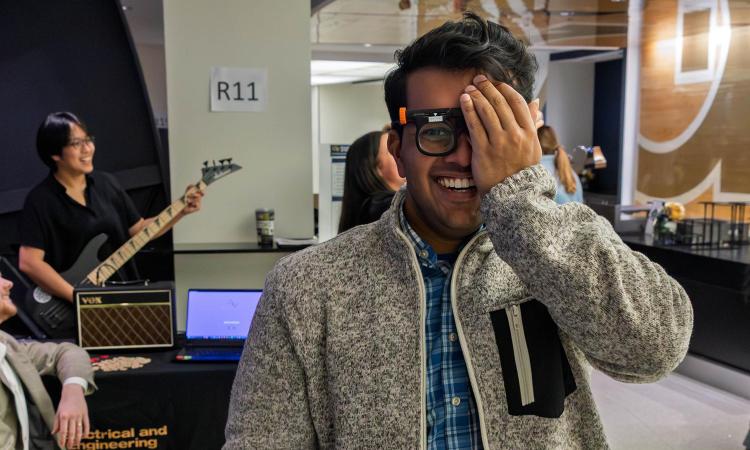
Project Sight improves children’s access to prescription eyewear in rural areas of low-income countries.
The interdisciplinary award went to Project Sight, an effort to improve access to prescription eyeglasses for children in developing countries. Their solution includes diagnostic glasses to help children identify their own prescription by simply turning a wheel until they can clearly read an eye chart. Then they select appropriate lenses from the included kit and pop them into frames that will fit nearly anyone ages 6-18.
“People in developing places have difficulty accessing quality eye care,” said mechanical engineering student Braden Anderson. “If we can empower them to do that themselves through a community-based kit that allows them to assemble their own lenses, that can change their lives and impact millions of people.”
Produced at scale, the team’s glasses could cost as little as a $1 per pair.
Work to refine their design and prepare it for mass production will continue next semester. That’s because Project Sight is one of four teams that were part of a new initiative in the George W. Woodruff School of Mechanical Engineering called Design for Planet Impact where students create technologies to address challenges in Guatemala. Another team developed a filter for removing arsenic from drinking water and won the top prize among mechanical engineering teams.
Elsewhere at the Capstone Design Expo, a suite of sensors and software to warn bike riders of an impending breakdown was judged best among the electrical and computer engineering projects. A team of mechanical engineers and industrial designers who also had cyclists in mind won honors for their augmented reality glasses for riders 55 and older.
The top civil and environmental engineering team redesigned a busy intersection in Peachtree Corners, Georgia, to improve traffic flow and better protect students walking to and from a nearby school. Among aerospace engineering teams, judges picked a design for an all-electric urban air mobility vehicle.

Team Chief’s device improves communication between service dogs and their handlers by providing haptic feedback to the dog, corresponding to a gesture from the handler.

HaloFit is a wearable fitness tracker designed as a lightweight, comfortable headband that provides continuous and accurate biometric monitoring.

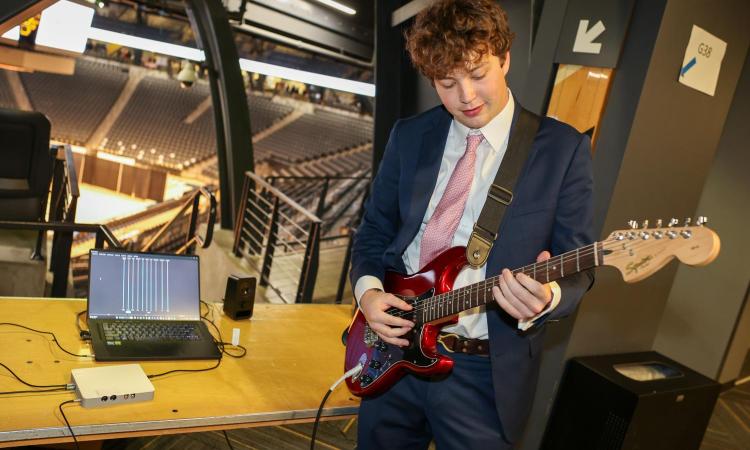
The VIP Autonomous Robot performs fault detection and response tasks in coordination with power grid simulations, improving efficiency, safety, and reliability of grid maintenance.
Other posters, projects, and prototypes packed the concourse of McCamish Pavilion, including:
- Several designconcepts for a new U.S. Navy fighter jet.
- An automated tourniquet to help first responders or bystanders quickly and effectively stop blood loss in emergencies, combat, and other high-stress situations.
- Systems to improve operations at the Hyundai Metaplant in Bryan County, Georgia.
- Helping golf courses find the perfect spot for each hole’s pin to create the most competitive and entertaining tournaments.
Students also developed robots for farms and to help power companies maintain and repair the electric grid. Several teams offered guidance and optimization tools to Atlanta-area nonprofits so they can help more people more efficiently.
The Capstone Design program is supported by philanthropic donations that are part of Transforming Tomorrow: The Campaign for Georgia Tech, a more than $2 billion comprehensive campaign designed to secure resources that will advance the Institute and its impact — on people’s lives, on the way we work together to create innovative solutions, and on our world — for decades to come.
See all the winners from Capstone Expo below and visit expo.gatech.edu for more projects.

InVision uses an antenna array and sensors to accurately image through drywall, revealing studs, pipes, and wiring, eliminating the need to damage the wall to see what's behind it.

MORPH is a robot that can overcome both large obstacles and fit in tight crevices to be quicker and more successful during search-and-rescue missions.

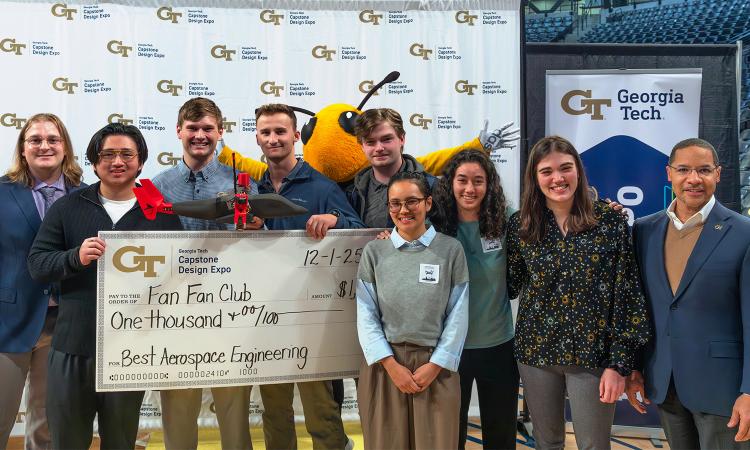
Team Fan Fan Club created a fully electronic version of NASA and Bell's XV-15 aircraft, which takes off, lands, and flies like a helicopter but is designed for urban air mobility.

Team Titans designed a reusable, portable water bottle for flavored drinks that allows for flavor control, mixing, and customization.
(text and background only visible when logged in)
(text and background only visible when logged in)
Capstone Results
Bladder Buddies
OVERALL BEST PROJECT
Wearable device for urinary incontinence monitoring and alerts
- Grace Nhan, EE (Saint Paul, MN)
- Carmen Rai, BME (Plano, TX)
- Rikhil Seshadri, CmpE (Woodbury, MN)
- Aric Ting, EE (Marietta, GA)
- Samyukta Iyer, BME (Marietta, GA)
Team Sight
INTERDISCIPLINARY
Adjustable glasses for children in developing countries
- Braden Anderson, ME (Kalispell, MT)
- Katherine Britt, ID (Savannah, GA)
- Kathleen Coleman, ME (Aiken, SC)
- Patrick Ferris, ME (Douglas, GA)
- Alexis Iaryczower, ME (Suwanee, GA)
- Rebecca Scarbrough, ID (Douglasville, GA)
Fan Fan Club
DANIEL GUGGENHEIM SCHOOL OF AEROSPACE ENGINEERING
eVTOL design for MARTA urban air mobility
- Sofia Arner (Golden)
- Aidan Bedwell (Frederick, MD)
- Ruhit Biswas (Lilburn, GA)
- Rivaldy Gaghana (Los Angeles, CA)
- Emma Joly (Huntsville, AL)
- Jarrett Latty (Dahlonega, GA)
- Daleiah Moniz (Atlanta, GA)
- Sonia Thakur (Lawrenceville, GA)
- McCay Turner (Mineral Bluff, GA)
- Andrew Wood (Johns Creek, GA)
Lightning McHeal
WALLACE H. COULTER DEPARTMENT OF BIOMEDICAL ENGINEERING
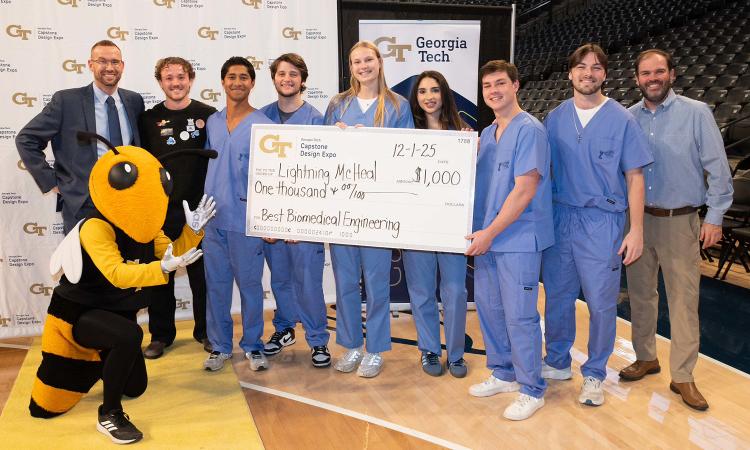
Cold plasma therapy for chronic wounds
- Layla Al Ribi (Abu Dhabi)
- Andrew Altman (Augusta, GA)
- Anna Boezi (Troy, OH)
- Karlo Jukic (Pittsburgh, PA)
- Sushrith Panda (Macon, GA)
- Dalton Spivey (Vidalia, GA)
MPLS Consulting
SCHOOL OF CIVIL AND ENVIRONMENTAL ENGINEERING
Peachtree Corners intersection improvement
- Samuel Cushman, EnvE (Columbus, OH)
- Phoebe Ellis, CE (Atlanta, GA)
- Meghan McGurk, CE (Harrison, NY)
- Lauren Sisk, CE (Hopkinsville, KY)
Bike Buddy
ELECTRICAL AND COMPUTER ENGINEERING
Embedded hardware for predictive bike maintenance
- Aniket Garg, CmpE (San Diego, CA)
- Jason Hsiao, CmpE (Bellevue, WA)
- Harris Nesteruk, CmpE (Kingsland)
- Leandro Odorici, CmpE (Rio de Janeiro, Brazil)
- Keshav Parthasarathy, CmpE (Suwanee, GA)
- Gate Tangchartsiri, CmpE (Bangkok)
Serving Solutions
H. MILTON STEWART SCHOOL OF INDUSTRIAL AND SYSTEMS ENGINEERING
Optimizing processes for North Fulton Community Charity food bank
- Samhith Aravind (Suwanee, GA)
- Sachin Bharadwaz (Atlanta, GA)
- Shaktik Bhattacharyya (Atlanta, GA)
- Elyse Daniel (Roswell, GA)
- Erin Hinnegan (Williamstown)
- Emma MacGregor (Atlanta, GA)
- Zora Ripkova (Bratislava, Slovakia)
DIME
INDUSTRIAL DESIGN AND ENGINEERING
Heads-up display glasses for road cyclists
- Zachary Campbell, ME (Atlanta, GA)
- Owen Ho, ME (Duluth)
- Sabah Ferdowsi Saba, ID (Chattogram)
- Adam Saint-Jacques, ID (New York, NY)
- Grace Tseng, ID (Atlanta, GA)
Ramblin’ Mech
GEORGE W. WOODRUFF SCHOOL OF MECHANICAL ENGINEERING
Home water filtration system for Guatemala
- Grace Clopton (Chicago, IL)
- Evan Goldstein (Los Angeles, CA)
- Paxton James (Newnan, GA)
- Amber Mistry (Wellington, FL)
- Virginia Weston (Decatur, GA)
Project Name
SCHOOL OF PUBLIC POLICY
brief description of project
- Name (City, State)
- Name (City, State)
- Name (City, State)
- Name (City, State)
- Name (City, State)
(text and background only visible when logged in)
Honorable Mentions
- Medmetrics, BME
- SafeScope, BME
- Sock ’Em, BME
- Streamline, BME
- SleepSound, BME
- Joint Discovery, Interdisciplinary
- Leave No Trace, BME
- The Storks, BME
(text and background only visible when logged in)
Related Stories
Woodruff School Showcases Bold Designs at Fall 2025 Capstone Expo
Mechanical engineering students presented projects including water filtration systems, affordable eyewear, and AR technology for cyclists.
BME Students Earn First Place as Bladder Buddies Tops Fall 2025 Capstone Expo
Interdisciplinary teamwork and bold ideas shine as students tackle real-world challenges — and earn a shot at the InVenture Prize.
Team Fan Fan Club Took Off with the Highest Honor in AE
The top aerospace Capstone project put an electric spin on urban air mobility.
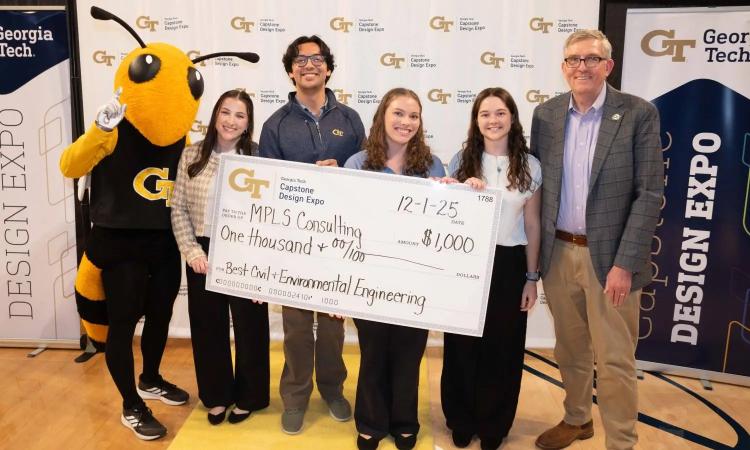
Unique Intersection Design Wins Best CEE Capstone Project
The project focused on alleviating traffic congestion and improving pedestrian safety with a displaced left turn.
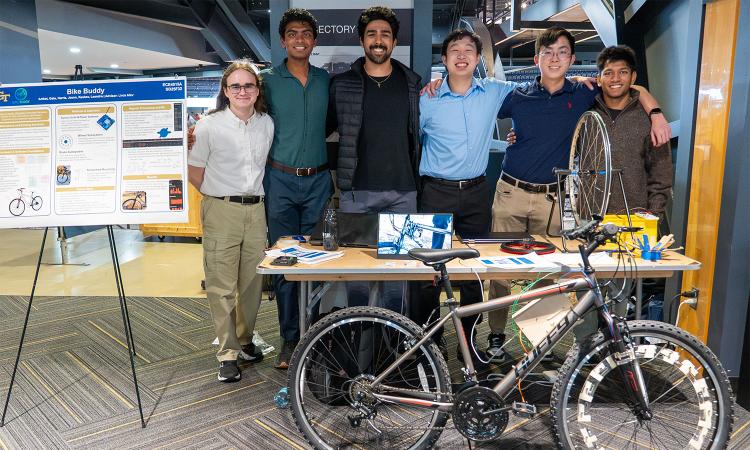
Bike Buddy Rolls to Victory as Top ECE Project
The predictive cycling system headlined an Expo packed with ECE innovations across health tech, wearables, financial computing, smart home automation, and more.
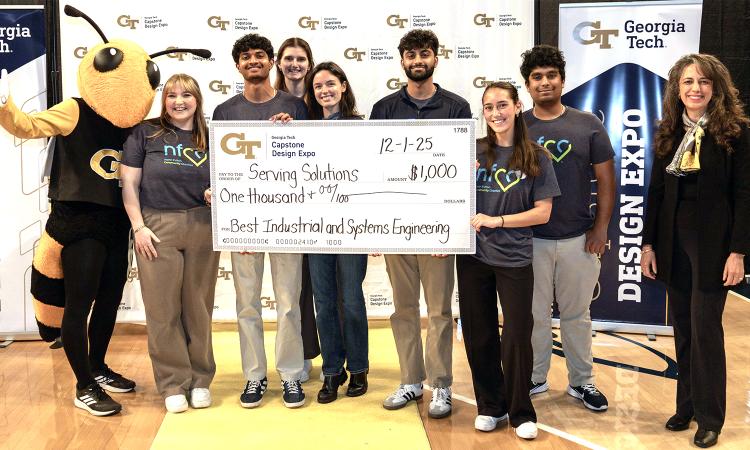
ISyE Students Serve Up Solutions to Hunger and Homelessness
The winning ISyE team increased operational efficiency and accessibility for North Fulton Community Charities.