
Students in Engineers Without Borders are partnering with a rural community in Nepal to design a system that will provide year-round access to clean water.

A group of women from the Chisopani Bhirkhe community in Nepal gather at one of the village’s spring-fed water sources. They spend hours each day fetching water from a series of contaminated and unreliable sources. (Photos Courtesy: EWB Georgia Tech)
In the small rural village of Chisopani Bhirkhe, Nepal, getting water for the 1,000 residents is a daily challenge.
Women spend hours climbing steep roads with heavy containers to access a limited number of water resources in the village — three springs that are contaminated and often run dry.
A team of Georgia Tech students in Engineers Without Borders (EWB) is working to change that.
A New Community Project
It’s the first time the Tech chapter of EWB has taken on a project in Asia.
“We wanted to continue addressing water scarcity because that’s where we already had experience,” said Anjali Balaganesh, a fourth-year biomedical engineering student and one of the project leads. “When we came across this community in Nepal, it was immediately clear that this was something we could make a real impact on.”
Every year, EWB-USA asks communities worldwide to submit descriptions of their needs, ranging from irrigation to sanitation. University chapters then apply to work with those communities.
For Georgia Tech’s team, the Nepal project aligned perfectly with both their technical expertise and their mission to apply engineering for global good.
“We read through the community’s submission and realized it was something we could really support with the resources and knowledge our chapter has,” said fifth-year mechanical engineering student Devasena Sitaram, who helped lead the application process.
Understanding the Challenge
Eventually, the team’s project will serve roughly 200 households in a mountainous region of Nepal where water is scarce and unreliable. During the dry season, the streams and springs in the area regularly run dry. Once that happens, communities face long walks to distant water sources.
Grace Jiang saw those challenges firsthand when she traveled to Nepal this summer.
“For a lot of the women, their entire day revolves around fetching water,” said the third-year civil engineering student. “They have small sources and one larger one, but they have to travel long distances and wait in line. A huge portion of their day is spent just getting enough water for their families.”
While on their five-day assessment trip, Jiang, Sitaram, and mechanical engineering student Nishita Tonangi surveyed water points, analyzed topography and water flows, and talked with community members to learn more about water shortages during the dry season. The students relied on a 16-year-old guide named Sabani for local knowledge and assistance during their trip.
“Having someone from the community showing us around made all the difference,” Jiang said, adding it helped them see not just the technical challenges but the human side of the problem.
(text and background only visible when logged in)

Mechanical engineering student Devasena Sitaram shows water testing strips to a group of children during her team's visit to Chisopani Bhirkhe, Nepal. (Photos Courtesy: EWB Georgia Tech)

EWB Georgia Tech team members Grace Jiang, Devasena Sitaram, and Nishita Tonangi focused on listening to community members, engaging with schoolkids, and evaluating water sources during their trip to Nepal.
Designing Solutions
The students’ goal is to develop and deploy a water supply system that has capacity to serve all 200 households in Chisopani Bhirkhe during even the driest parts of the year. Once they create a plan, the team will return to Nepal to begin to implement their system alongside the locals.
“Before we even started designing anything, we wanted to listen first,” Balaganesh said. “The trip reminded us that good engineering starts with understanding the people you’re building for.”
The group is investigating a series of methods to stabilize water supply, including constructing a groundwater recharge pit to filter water into the underground aquifer, installing tap stands connected to a water supply system, and searching for a new long-term well.
Altogether, the team estimates their work will cost $100,000. They’re searching for sponsors and fundraising through EWB-USA.
“Even from the start, the community was incredibly engaged,” Sitaram said. “They told us what challenges they face every season and what’s worked before. That collaboration is what makes the project sustainable.”
Every EWB project is developed with community engagement at the forefront and residents included in every aspect. Local buy-in helps ensure the ultimate solution lasts, both technically and socially.
Back in Atlanta, the team is finalizing water source analyses, drafting design alternatives, and planning their next visit to Nepal. They’re hoping to finish design work this spring and then start implementation of their solutions in Chisopani Bhirke in fall 2026 and spring 2027.
“Seeing how much time these families spend just getting water really put things into perspective,” Jiang said. “It’s easy to talk about sustainability in class, but witnessing the need firsthand made it real.”
Related Content
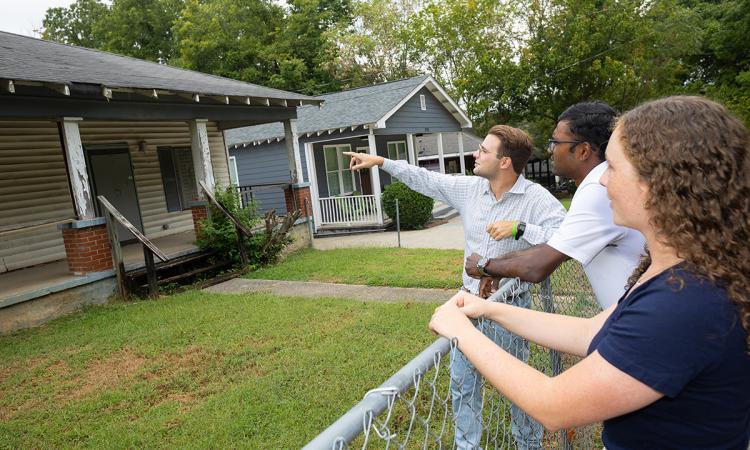
Building a Legacy
What started as a student design for a sustainable building competition soon will be a net-zero-energy home in Atlanta’s historic Vine City neighborhood.
What started as a student design for a sustainable building competition soon will be a net-zero-energy home in Atlanta’s historic Vine City neighborhood.
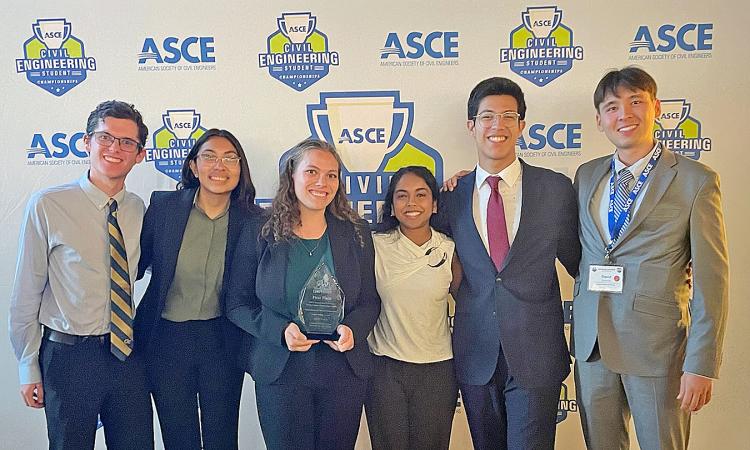
Three-Peat: Sustainable Solutions Team Wins National Competition Again
The team of civil and environmental engineering students won first place in the American Society of Civil Engineers challenge, which asks groups to incorporate sustainability into everyday engineering problems in creative ways.
School of Civil and Environmental Engineering
The team of civil and environmental engineering students won first place in the American Society of Civil Engineers challenge, which asks groups to incorporate sustainability into everyday engineering problems in creative ways.
Ping Fellow Victor Brandão Committed to Finding Sustainable Solutions
The ChBE Ph.D. student's childhood in Brazil inspired an interest in sustainable engineering, which he's channeled into research he hopes will help the world address carbon emissions.
School of Chemical and Biomolecular Engineering
The ChBE Ph.D. student's childhood in Brazil inspired an interest in sustainable engineering, which he's channeled into research he hopes will help the world address carbon emissions.