
Using patterned light to generate and control microscale forces could inform designs for synthetic cells that deliver drugs.
(text and background only visible when logged in)
Engineers interested in creating artificial cells to deliver drugs to unhealthy parts of the body face a key challenge: for a cell-like system to move, change shape, or divide, it needs a way to generate force on command.
Biological cells rely on adenosine triphosphate (ATP) to move muscles, transport substances across membranes, and perform other functions. Many cellular machines couple ATP hydrolysis (a process where chemical energy stored in ATP is released) directly to motion.
But some single-celled organisms called ciliates use a different strategy. A pulse of calcium triggers an ultrafast contraction, and ATP is used afterward to pump calcium back into storage and reset the system.
In a Nature Communications study led by Georgia Tech, researchers learned how to use a similar mechanism to control the movements of artificial protein networks without relying on ATP-powered motor proteins. Instead, they used calcium as a trigger to make the networks contract or relax.
“If engineers want synthetic cells that can do cell-like things, they need a way to generate force on command,” said Saad Bhamla, a co-author and an associate professor in Georgia Tech’s School of Chemical and Biomolecular Engineering. “Cells have to move, change shape, and divide. We’re trying to build a controllable engine from simple parts.”
In the National Science Foundation-funded study, the team produced and purified Tetrahymena thermophila calcium-binding protein 2 (Tcb2), which is found in ciliates. The protein forms a fibrous network and contracts when exposed to calcium. The researchers reconstituted Tcb2 protein networks in the lab and then used a light-sensitive calcium chelator (a “cage” molecule that holds the calcium until illuminated) to control when and where calcium was released.
They projected light patterns of stars and circles to prompt the network to assemble and contract in matching shapes. Then, to continuously “recharge” the system, the multi-university team pulsed the light on the protein networks, repeatedly releasing calcium and driving cycles of assembly and contraction.
“The light cleaves a ‘cage’ molecule holding calcium, releasing calcium only where the pattern is projected,” said Xiangting Lei, a Georgia Tech chemical engineering Ph.D. graduate who co-led the study. “With pulsed illumination, the network can contract repeatedly over approximately 150 cycles, with contraction speeds about 0.4 micrometers per second.”
The team also demonstrated transport of microscopic particles using the network’s forces, a step toward controllable actuation that could be useful in synthetic-cell-like delivery systems.
The next step was making a computer model to understand how Tcb2 expanded under different inputs.
“The pulsing allowed us to repeatedly contract the network,” said Carlos Floyd, a co-author and postdoctoral fellow at the University of Chicago. “By using simulations and reinforcement learning, we learned how to generate light patterns that controlled the network to push or pull according to our wishes.”
The work grew out of Bhamla’s bioinspired engineering lab, which has previously built springtail-inspired jumping robots and water-strider-inspired swimmers. He pointed Lei toward ciliates as a source of controllable contraction.
“Most molecular machines burn ATP directly, like a gas engine,” Bhamla said. “But ciliates use a different design. They use ATP to recharge calcium stores, and then a pulse of calcium triggers an ultrafast motion. It’s closer to a Prius than a pure gas engine. You charge the calcium ‘battery’ and release it on demand.”
Bhamla said that a controllable force generator is a missing component for many synthetic-cell concepts. The team’s light-controlled calcium “engine” provides one route to that capability, with the precision to place forces where they’re needed.
(text and background only visible when logged in)
About the Research
This research was supported in part by the National Science Foundation, grant Nos. MCB-2313725, MCB-2313723, MCB-2313727, and MCB-2313724; and the National Institutes of Health, grant No. R35GM142588. Any opinions, findings, and conclusions or recommendations expressed in this material are those of the authors and do not necessarily reflect the views of any funding agency.
Citation: Lei, X., Floyd, C., Casas-Ferrer, L. et al. Light-induced assembly and repeatable actuation in Ca2+-driven chemomechanical protein networks. Nature Communications 17, 3016 (2026). https://doi.org/10.1038/s41467-026-69651-2

Preeminence in Research
Related Content

Engineering A Robot That Can Jump 10 Feet High – Without Legs
Studying a leaping, body-bending parasite thinner than a human hair led Georgia Tech engineers to create a soft robot that can hop forward and backward.
Studying a leaping, body-bending parasite thinner than a human hair led Georgia Tech engineers to create a soft robot that can hop forward and backward.
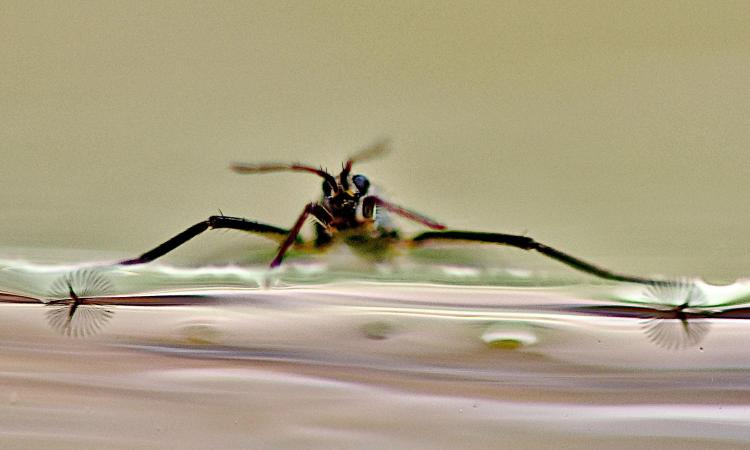
Tiny Fans on the Feet of Water Bugs Could Lead to Energy Efficient Mini Robots
Researchers built an insect-sized robot that uses surface water and collapsible propellers as an idea to improve fast-moving machines that can operate in rivers or flooded areas.
Researchers built an insect-sized robot that uses surface water and collapsible propellers as an idea to improve fast-moving machines that can operate in rivers or flooded areas.