
With automated drone battery swapping stations and drone-in-a-box systems, alumni Curt Lary and Nicholas Mulka are using their Georgia Tech know-how to expand access to aerial data collection and security monitoring.
(text and background only visible when logged in)
Nicholas Mulka was working on his master’s thesis when Curt Lary called and changed everything.
The longtime friends met while studying mechanical engineering at Georgia Tech. They had joined the same fraternity, taken the same classes, studied together, and bonded over shared interests.
“Also, there was a little bit of healthy competition throughout undergrad,” Mulka recalled with a laugh. “Like in our circuits class, Curt would study less than me and get a better score on the test. And I would always be like, how did this happen?”
The two had remained close, even as Lary returned to his native Miami after graduating in 2020 and started working on an idea in his family garage that would upend the typical limits of operating autonomous drones. It was the outgrowth of his Capstone Design senior project, and Lary had decided to go all-in on it.
“Coming out of Capstone — and I’ve been through a lot of the different entrepreneurship courses at Georgia Tech, such as Idea to Prototype — I was clear about the path: find a customer and then solve the customer’s problem. That’s step one,” Lary said.
“I knew I wanted to make cool things with drones, but I needed to solve a critical problem. And everyone I talked to using a particular drone said, ‘If you can automate it so that our missions can be truly automatic, then we’ll buy.’”
What Lary ended up making in his garage sounds a bit like science fiction: An automated station where a drone lands, the station automatically swaps its depleted batteries for fully charged ones, and the drone takes off again to resume its mission. No human intervention required.
Growing a Good Idea
With the customers’ problem solved, Lary sold his first units. And things started to take off.
Before long, he realized he needed help from good engineers to keep growing. That’s when he called Mulka, who soon moved to Miami with just a suitcase in hand and a thesis to finish.
The pair spent months grinding away in their warehouse-slash-manufacturing facility-slash-office. They worked to the point of exhaustion almost every day, collapsing onto air mattresses in the warehouse each night to sleep.
Now the company, called Hex, has dozens of clients and hardware deployed in 20 states and two dozen countries. They’ve grown to more than 30 employees working in a 10,000-square-foot facility in South Florida. And they’re shipping out up to five drone stations every week.

Nicholas Mulka (left) and Curt Lary with the Hex automated drone docking station. (Courtesy: Hex)
Their customers use drones to inspect and monitor oil and gas facilities, critical infrastructure, train tracks, and railroad yards. Drones support private security teams and public safety — for example at large events or in emergency situations, where drones launch from a Hex station after a 911 call and can be at the scene in 90 seconds or less. That gives first responders near-immediate eyes on a situation while they’re still en route.
“We allow our customers to get the maximum utility out of a drone,” Lary said. “They don’t want to wait 30 minutes for it to recharge, and so the battery can be swapped in two minutes and they’re ready to go. They can fly two or three times as long.
“It’s a hard problem — a lot of mechanical systems that need to work together continuously and reliably in a ton of different environments.”
Hex started as a hardware company, developing a station for larger drones and another for small ones. More recently, Lary and Mulka have expanded, developing software solutions to create what they call a drone-in-a-box system — everything customers need to plan missions, capture and analyze data, and automatically deploy.
“We allow our customers to get the maximum utility out of a drone. They don’t want to wait 30 minutes for it to recharge, and so the battery can be swapped in two minutes and they’re ready to go. They can fly two or three times as long.”
CURT LARY
“We just want to make aerial data acquisition a lot more obtainable for a lot more people,” Mulka said. “Being able to have high-fidelity, high-frequency aerial data for the large industrials, but also for other clientele that might need it — real estate, insurance, agriculture, security — and then being able to provide a data acquisition layer potentially for AI-driven models, I think, is going to be a powerful future for us.”
Creators from the Start
Back in their undergrad days, one of the pair’s shared interests was entrepreneurship. Both seemed always to be building something.
“That is one of the things that made us friends — I would show off some of the projects I was building. And we’d talk about entrepreneurship,” Mulka said. “I wanted to build something that was an electromechanical system of some sort. One of my projects was a game pad that would be paired with an iPhone. I had another project thinking about accessories that you could carry around. But nothing that was super serious.”
Still, Mulka’s dad had started his own business, so he’d always wanted to create.
“It really wasn’t until Curt came to me and was like, ‘Let’s make this happen,’ that I felt like, OK, this is something I can really sink my teeth into.”
Likewise, Lary had the startup bug from a young age. His grandfather had been a heart surgeon and inventor with dozens of patents for medical innovations.
“This is super cliché: in kindergarten, they asked what I wanted to be. I said, ‘An inventor, and I want to make a flying car,’” Lary said. “When you’re a kid, you set pretty high aspirations, and I’m trying to uphold them.”
(text and background only visible when logged in)
(text and background only visible when logged in)
Related Stories
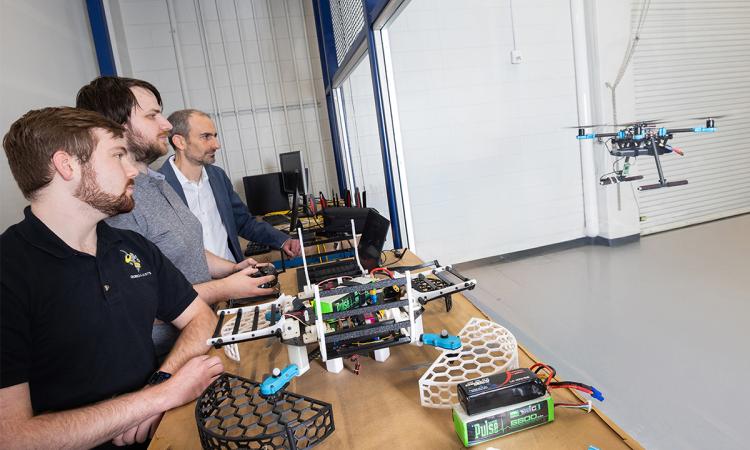
Behind the Lab Doors
Take a look inside the Indoor Flight Lab and other unique spaces in the College.
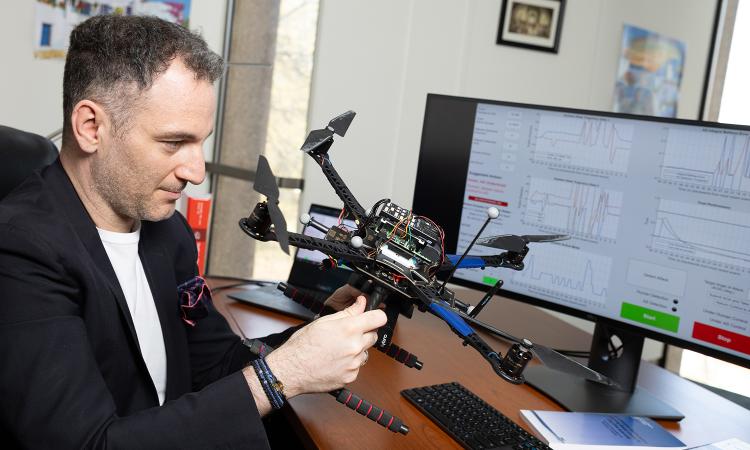
Winning the Zero-Sum Game
In the quest to ensure drones and other autonomous vehicles operate safely, engineers have to out-think the malicious attackers who might try to take over.
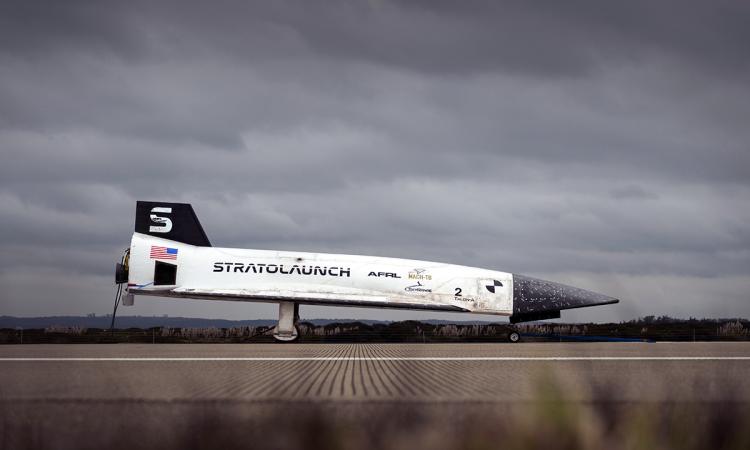
At One Mile Per Second, Opportunities Come Fast
Aerospace engineering alumnus Zachary Krevor is working to make hypersonic flight cheaper and more accessible so the U.S. can meet the demands of a Mach 5+ future.

Helluva Engineer
This story originally appeared in the Spring 2026 issue of Helluva Engineer magazine.
We’re taking you behind the scenes to some of the hidden (and not-so-hidden) labs across the College where Georgia Tech engineers are shaping the future. In these places, robots swim in a mini ocean or crawl across the moon’s surface, huge concrete beams loom, and invisible gas or high-frequency radio waves fly across the room. We’re also unwrapping how researchers help industry partners solve tough problems and improve their processes. Plus, a few students talk to their younger selves and look back at four years of growth on North Avenue.