

(text and background only visible when logged in)
Collaborating with industry gives companies access to world‑class expertise and new ideas. For students and faculty, it’s a direct line to the challenges defining real‑world engineering.
(text and background only visible when logged in)
In Georgia Tech research labs, engineers pursue all kinds of questions. Some come from funding agency priorities or foundations interested in specific areas. A news story or community need might spark an idea. Conversations with colleagues and students can yield new areas to explore.
Other questions, though, come straight from the real world — a challenge faced by a manufacturer, a tech company, or a government agency. They bring urgency, context, and problems that matter; Tech engineers bring expertise, creativity, and a relentless desire to understand how things work — and how they can work better. For students, it’s a front‑row seat to engineering as it happens beyond campus.
Companies are stepping into the classroom, too, where faculty members draw industry into the College’s curriculum to help shape the skills and tools engineers learn, making them workforce-ready after college.
From laboratories to factory floors and semiconductor cleanrooms to busy Atlanta highways, industry collaboration in the College shows what’s possible when companies and academia learn from each other, push each other, and build solutions — together.
How Aluminum Cans Keep Beverages Bubbly
The aluminum beverage can in your fridge is an engineering marvel, able to keep your soda, energy drink, premade coffee, or beer fresh and, usually, bubbly. That’s made possible in part by a thin protective layer inside the can that keeps the contents from interacting with the metal — and the other way around.
Sometimes the protection degrades, though, weakened by acids, alcohols, or other beverage ingredients that affect the coating’s barrier properties and its adhesion to the metal.
School of Chemical and Biomolecular Engineering researchers have created unique, powerful tools that collect data to analyze those interactions. Led by Associate Professor and Robert G. Miller Faculty Fellow Nian Liu, their work is part of a long-running partnership with Novelis, the Atlanta-based company that’s a leading global supplier of aluminum sheet for beverage cans.

Materials science and engineering master’s student Enpei Yao (left), Nian Liu, and ChBE undergraduate Jesse Jang test real beverage can samples in the lab. (Photo: Candler Hobbs)
“We have built this capability to measure conditions very frequently in a can filled with a beverage of interest. It allows us to see the evolution of problems, rather than just at the end,” Liu said. “Typically, the standard industry testing would happen after a failure, but we can provide data throughout the duration of a test. So that’s very valuable.”
Standard tests assessing how beverages interact with the coatings and metal of the can sometimes require months to run, and they use stand-ins for specific food and beverages rather than real products. Novelis needed to improve those experiments so they could use real beverages at higher temperatures and pressures that reflect the real world, such as the conditions cans might be exposed to during transport and storage.

The team collects data on real-world temperature and pressure conditions that the beverages might be exposed to.
With Novelis’ support, Liu and his students have refined the process. Now they get results in just a few weeks from pressurized cans with actual product. And instead of taking measurements every few days, they do it every hour. The researchers also can separate the effects of the beverage, temperature, and pressure.
Liu doesn’t make judgments about causes. Rather, he provides Novelis’ teams with detailed data and material characteristics they need to design their processes and products to perform better.
“They will send us real beverage can samples and then we do the analysis to understand how various beverages interact with the coatings and metal,” Liu said. “That work has a very short turnover, and the data must be reliable so they can draw the appropriate conclusions.”
The partnership means Novelis can tap into the creativity, expertise, and advanced tools available at Tech. It also means Liu’s students get a taste of working with industry and how companies quickly address problems.
“The partnership with Professor Liu and his team has been extremely fruitful,” said Juraj Liska, senior principal coatings scientist at Novelis. “The ability to perform this testing in a much shorter time and to also gain scientific insights means that we can accelerate the pace at which we develop new coated sheet products for our customers and the beverage can market.”
Liu’s main research interests focus on high-energy battery technology and tools to visualize battery reactions — not aluminum cans. But he said that’s the value of working with industry partners.
“Novelis brought this specific problem to us; I would never have come to it on my own,” he said. “There are so many problems in the world, and I’m looking at the news and at funding agency priorities, which guide me to what I can work on. I never would have realized this research need without their partnership.”
(text and background only visible when logged in)
Driving Georgia’s Transportation Innovations
A similar kind of partnership is what drove Tech engineers to evaluate a proposed safety intervention where two major north-south interstates meet north of Atlanta’s downtown.
In this area, I-75 and I-85 unite for a few miles, carrying nearly half a million vehicles through the city every day. Just ahead of this merger, drivers traveling south on 75 who want to swing around to 85 toward the northeast part of metro Atlanta must navigate a sharp curve.
A few years ago, GDOT added a series of raised, painted chevrons on that ramp as a visual and physical cue to drivers that they need to be alert and slow down. It was a technique used elsewhere to improve safety, and GDOT wondered if the chevrons would do the same at that tricky interchange and another north of town at I-75 and I-285. Enter Georgia Tech civil engineers, who studied a test implementation of the tightly packed chevrons to assess their impact.
In the end, they found a significant reduction in crashes after the chevrons were installed, though not a significant reduction in speed.
“It ended up being a very effective treatment. But it wasn’t for the reason we thought,” said Michael Hunter, a professor in the School of Civil and Environmental Engineering (CEE) who led the study. “What we suspect happens is drivers suddenly see all this paint on the road, and that is not typical. And you get this feeling of driving over 100 rumble strips. It essentially alerts people that conditions are changing, and it makes them more alert.”
Those chevrons are one highly visible example of how Georgia Tech engineers work with state transportation officials to improve Georgia’s roads.
Every year, researchers tackle a handful of projects to support GDOT. They might result in a safety improvement, like the painted chevrons, or the findings could become an organizational or policy change. Research might influence how overpasses and bridges are built or help the agency wrangle mountains of data and digital systems across its departments to improve decision-making and operations.
The key for each project is a tangible outcome or some real-world advance.
“When you want to work with a DOT, it’s very important that you understand what its challenges are,” Hunter said. “The endgame is not a paper that gets cited a lot; it’s something in the field: Can you change a standard or guide document? Can you advance the way they’re doing construction planning or meet whatever the need is?”

Michael Hunter (Photo: Candler Hobbs)
One of Hunter’s favorite projects is one of the first he worked on with GDOT.
When traffic signals encounter an issue, they switch to a default flash mode. For many years, the signal would flash a yellow light on the main road and a red light on the intersecting road.
After a fatal wreck at one of these flashing signals, GDOT wanted to understand how to make similar situations safer. Hunter and his team started collecting data from intersections where signals defaulted into the flash mode to see how drivers behaved.
They quickly saw the confusion. Drivers didn’t know whether to stop or go, or who had the right of way. So his team recommended a change: flash red in every direction when a signal malfunctions.
“It was a complete change in the way you look at it,” Hunter said, “because when you’re flashing red and yellow, you’re trying to keep the main line moving. Let the side streets take the delay until a truck can get out to fix the issue. What we found is, you can’t count on drivers to understand what they should do in this situation. The behavior of other drivers can seem very unpredictable, leading to an increased likelihood of conflicts. Flashing everything red is the safest possible option.”
Their work was convincing, and the state changed the standard.
“It reduced the confusion that causes those crashes,” Hunter said. “I would bet that project saved lives.”
Beyond specific projects, Georgia Tech’s partnership with GDOT extends through the Georgia Transportation Institute, which Hunter leads. The organization includes 10 other universities across the state, facilitating knowledge transfer between higher education and GDOT and ensuring the agency’s needs are met.
“In the end, it’s Georgia taxpayers’ dollars being spent,” he said. “By working with GDOT, we seek to serve citizens to the best of our ability.”
(text and background only visible when logged in)
Repairing Concrete Girders
One recent project supporting GDOT tapped Tech’s structural engineering expertise to reduce the waste and delays caused by issues with the huge concrete girders used to build bridges and highway overpasses.
Sometimes those girders — up to 160 feet long in some cases — are damaged slightly when the formwork is removed after the concrete cures. Or they can be damaged as they’re transported to the construction site. In either case, the girders might be rejected, and then a new one must be made. The production process takes at least 45 days, which can grind a bridge project to a halt for weeks.
(text and background only visible when logged in)

Students pour concrete for a test girder (right) and inspect damage during testing (left). (Photos courtesy: Fred Meyer)
GDOT wanted to know if repairing girders with small amounts of damage would be a feasible alternative, delivering the same structural strength and keeping projects on track. Over the last year or so, civil engineers Fred Meyer and Lauren Stewart have been working to answer that question.
“These precast concrete plants are typically backlogged about a year. To have to make a new girder after one is damaged might mean using an entire 500-foot beam line to cast just that one girder,” said Meyer, professor of the practice in CEE. “It’s very inefficient and could push their whole production process back several days.”

As part of the GDOT project, the researchers and a trio of graduate students worked with a precast concrete company to make four girders, using foam and insulation in the concrete formwork to create pockets of simulated damage in the most common areas. At 45.5 feet long and more than 4 feet tall, each beam clocked in at 15 tons.
The team used industry standard repair techniques to fix the damage they created, then built a concrete deck on top of each refurbished girder so it would behave like an actual bridge section. Altogether, that brought the weight to 30 tons. In a series of tests, the team pushed the girders to their limits, loading them with hundreds of thousands of pounds of force to see how the repairs held up.
It worked: the majority of the repairs did exactly what they were supposed to do, restoring the girders’ original performance — and even exceeding it in a few cases.
“We’re hoping this report shows that these repairs do work,” Meyer said. “The girder will behave just as an undamaged girder would, and it will save money in the big picture.”
The team has delivered a final report to GDOT to evaluate. No matter what the agency decides to do, Meyer said the project was a valuable experience for the students who spent countless hours making, damaging, repairing, and testing the girders.
“It was a very hands-on project that allowed students to get in and really see how these girders are made and how they behave,” he said. “They learned a lot about the whole construction process. It was a great project for us to work on.”
(text and background only visible when logged in)
Capstone Project Delivers for Sock Packaging Line
Companies don’t just partner with faculty members and research labs to access Georgia Tech’s intellectual power. They also tap into students, often through senior design courses.
For Colombian apparel company Crystal S.A.S., working with a capstone design team created an automated process that quadrupled productivity on a sock packaging line while improving consistency and decreasing variability. Automating a time-consuming and labor-intensive process freed team members to focus on higher-value activities instead of manual packaging. And it meant the company could deliver better results for clients.
“We wanted to redesign the whole process, not just optimize it,” said Juan Esteban Escobar Gómez, an engineer at Crystal who worked directly with the students. “Our objective was to multiply productivity and be more efficient. And we wanted to reduce dependency on repetitive manual labor, because it’s very difficult right now to find people who want to work on those manual operations.”
The repetitive movements required to assemble boxes, insert socks, tag them, and apply stickers risked stress injuries such as carpal tunnel syndrome for operators. The process also meant the time to complete a package varied wildly from worker to worker.
Gómez said Crystal constantly evaluates how things are done on the plant floor. And this part of the production line seemed ripe for improvement. But before Crystal invested time and money in automation, they needed to know if it even made sense to pursue.
“Instead of jumping directly into building a new machine, we want to answer that question first: is this automation actually viable and feasible for us to make? The capstone program offered us a very structured engineering approach, fresh and unbiased problem solving, and the rapid concept validation through prototyping that we lacked,” Gómez said. “The students started working very quickly on offering alternatives and trying to understand the constraints of the process.”

Crystal engineers (right inset) developed the students’ prototype into a factory-ready machine (center). (Photos courtesy: Crystal S.A.S.)
A team of six electrical and mechanical engineering students developed design alternatives, created a working prototype, and tested it. Ultimately, they settled on a rotating turnstile design to fold and seal a box before ejecting it into another other system to complete tagging and final packaging.
Not every idea they presented worked, Gómez said, but it kept him and his team at Crystal thinking and challenging their own processes. And the collaboration proved that automating the packing and tagging was worthwhile. So, Crystal’s engineers took the students’ prototype and industrialized it — they made a factory-ready machine that could slot into the production line, running 24/7 and working 99% of the time. They also added modules to apply stickers to the box, insert socks, and tag them, creating a fully automatic process.
Working with the students allowed Crystal to validate their concept and reduce the uncertainty inherent in overhauling a key manufacturing process, Gómez said. But more than that, it helped the company rethink how they approach improving their operations. Partnering with Tech reduced risk for the company, sped innovation, and multiplied its capabilities — shortening the time from seeing a need to having a tangible solution.
“In the market we operate in, opportunities come and go really, really fast. So you have to offer solutions quickly and iterate constantly,” Gómez said.
“This partnership allowed us to validate a concept, which is where the most uncertainty is. Then you can actually focus and create a real solution for industry.”
(text and background only visible when logged in)
Advancing Accurate Robotic Manufacturing
In a Boeing-funded lab at the Advanced Manufacturing Pilot Facility, researchers are working on a very different kind of manufacturing technology. They aim to replace large, expensive machine tools with highly accurate robotic systems to help lower the cost of aircraft production.
For about a decade, mechanical engineer Shreyes Melkote and his students have improved the accuracy of industrial robots so they can perform precise manufacturing operations, such as trimming metal and composite structures. In Boeing’s airplane plants, these precise operations require enormous machines that cost millions of dollars and can’t be easily reconfigured or repurposed for new uses.
Melkote — and Boeing — see potential for using robots to do some of this work. They’re less expensive, smaller, and reprogrammable for new tasks. And they could help the company work through a years-long backlog of orders by boosting the rate of production. The problem is, robots just aren’t accurate enough to meet the aerospace industry’s requirements.

Undergraduate Khushi Shah (left), Shreyes Melkote, and Ph.D. student Tahsin Sejat Saniat are using computer vision and real-time control systems to make industrial robotic arms more accurate for aircraft manufacturing. (Photo: Candler Hobbs)
“These are very large structures being assembled, and maintaining precision in terms of dimensions and shape is not easy at that scale,” said Melkote, Morris M. Bryan Jr. Professor in the George W. Woodruff School of Mechanical Engineering.
“If you can overcome the accuracy limitations of industrial robots, then you can take advantage of all of their pluses in terms of lower cost, flexibility, reconfigurability, and their ability to essentially take a process to the part as opposed to take the part to the process. You can’t transport a fuselage section easily to a machine. If something needs to be reworked, you’d like to be able to rework it right on the line.”
With Boeing’s support, Melkote and his students have developed real-time control systems and computer vision to clear the accuracy hurdles. Now they’re embarking on merging those systems with the goal of trimming large, molded composite parts.
This is how it would work: Using a camera mounted on an industrial robotic arm, Melkote and his team scan a part and use artificial intelligence algorithms they developed to identify specific features molded into the part. That information feeds a real-time control system that uses lasers to track exactly where the robot is in space and then commands the robot to trim the part.
“We’ve spent several years to get to this point, and our understanding has improved significantly,” Melkote said. “Now we are bringing the research to a point where we demonstrated this integrated capability, and Boeing can then take it and develop a production-grade system. That’s my hope.”
Along the way, he added, his students are learning and being trained in what works and what doesn’t. That primes them to potentially be recruited to implement these kinds of next-generation precision manufacturing robots.
“The best transfer of technology is people,” Melkote said. “They’re the ones who know it — even better than I do.”
(text and background only visible when logged in)
Stacking the Tech Workforce
Aligning education with industry needs — and strengthening the nation’s workforce in critical technology fields — is why the School of Electrical and Computer Engineering (ECE) has created the Curriculum Partnership Initiative (CPI).
The program allows companies to contribute to course development and curriculum while giving students direct access to industry experts and industry-standard tools and methods.
“We are acutely aware of how rapidly our field evolves,” said Arijit Raychowdhury, Steve W. Chaddick School Chair of ECE. “A collaborative model with industry leaders is essential to meet the fast-paced demands of industry and best prepare future leaders. The CPI allows us to stay ahead by ensuring our curriculum is both current and forward-thinking, and providing our students with the tools and experiences they need to thrive in their careers.”
Ultimately, the goal is to reduce the time it takes for new employees to become fully productive in their roles. Shortening this period means recent graduates can make meaningful contributions from day one, Raychowdhury said: “Our students find that this hands-on approach not only prepares them for their future careers but also deepens their understanding of essential engineering principles.”

Left circle: ECE research assistant Tzu-Han Wang is one of the instructors for a new analog tapeout course. Center: A chip created by student groups in the course and embedded in a printed circuit board. Lower circle: Fernando Mujica, an Apple engineering director and 1999 ECE Ph.D. graduate, speaks to students. (Photos courtesy: ECE / Dan Watson)
About a year old, the initiative includes five focus areas that sync with the initial group of partners: Apple, Absolics, GlobalFoundries, Intelsat, and Texas Instruments.
Among the collaborations are new analog and digital “tapeout” courses developed with Texas Instruments and Apple, respectively. Tapeout is the final stage of the integrated circuit design process, where the completed design is sent to a fabrication facility for manufacturing. The courses offer undergraduate students the opportunity to explore the intricacies of the complete circuit design cycle, from system specification and architectural design to fabrication and testing.
With Absolics, ECE faculty members are collaborating on glass-based semiconductor packaging. GlobalFoundries lends expertise in 3D heterogeneous integration; Intelsat works with ECE on satellite communications.

“Working on industry-aligned projects in class was incredibly valuable and raised the stakes,” said Ethan Weinstock, who earned a bachelor’s and master’s in computer engineering in 2023 and 2024 and now works at NVIDIA. “It taught me the schedule, tone, and expectations of working in industry. The experience significantly benefited my transition to a working engineer.”
The Semiconductor Industry Association projects demand for employees like Weinstock will only grow in the next few years, with companies needing to fill 115,000 more jobs by 2030. The CPI aims to ensure one of the nation’s largest ECE programs is primed to address the demand.
It also has strengthened ties to industry collaborators. For example, Georgia Tech has joined Apple’s New Silicon Initiative (NSI). More than a single course, NSI allows ECE students to learn directly from Apple engineers in a variety of ways, enhancing their skills in microelectronic circuits and hardware design.
Likewise, CPI partners engage outside the classroom, connecting students with mentors, hosting networking events, and inviting company employees to deliver guest lectures.
Expanding on CPI’s early foundation, Raychowdhury said the School is actively looking for new areas of focus, including circuits and systems for sensing and communication, computer architecture, intelligent platforms, machine learning, packaging, and more.
(text and background only visible when logged in)
Related Content
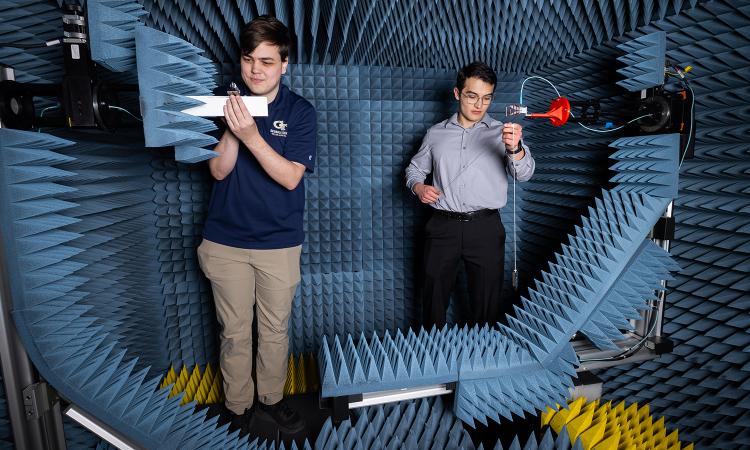
Behind the Lab Doors
With thousands of faculty and student researchers and countless research areas spread across eight schools, you never know what you’ll see when you visit a lab space.
With thousands of faculty and student researchers and countless research areas spread across eight schools, you never know what you’ll see when you visit a lab space.
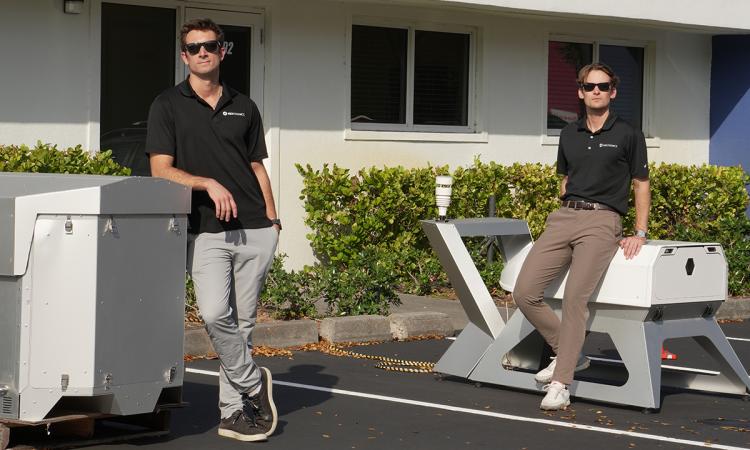
Eyes in the Sky
With automated drone battery swapping stations and drone-in-a-box systems, alumni Curt Lary and Nicholas Mulka are using their Georgia Tech know-how to expand access to aerial data collection and security monitoring.
With automated drone battery swapping stations and drone-in-a-box systems, alumni Curt Lary and Nicholas Mulka are using their Georgia Tech know-how to expand access to aerial data collection and security monitoring.
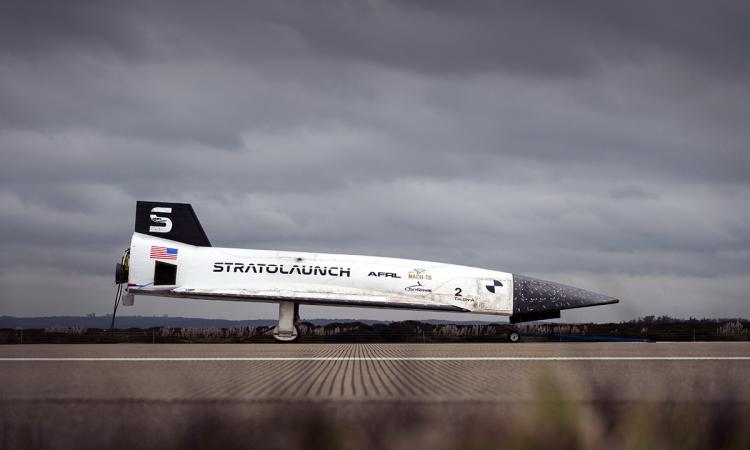
At One Mile Per Second, Opportunities Come Fast
As CEO of Stratolaunch, aerospace engineering alumnus Zachary Krevor is working to make hypersonic flight cheaper and more accessible so the U.S. can meet the demands of a Mach 5+ future.
As CEO of Stratolaunch, aerospace engineering alumnus Zachary Krevor is working to make hypersonic flight cheaper and more accessible so the U.S. can meet the demands of a Mach 5+ future.

Helluva Engineer
This story originally appeared in the Spring 2026 issue of Helluva Engineer magazine.
We’re taking you behind the scenes to some of the hidden (and not-so-hidden) labs across the College where Georgia Tech engineers are shaping the future. In these places, robots swim in a mini ocean or crawl across the moon’s surface, huge concrete beams loom, and invisible gas or high-frequency radio waves fly across the room. We’re also unwrapping how researchers help industry partners solve tough problems and improve their processes. Plus, a few students talk to their younger selves and look back at four years of growth on North Avenue.