
The spring 2026 showcase of senior design projects spanned engineering, design, computing, and liberal arts.
(text and background only visible when logged in)

(text and background only visible when logged in)
In one way or another, the three top teams at this spring’s Capstone Design Expo were trying to protect something.
Two of them tied for the best overall project: one with a portable defense against enemy drones to protect soldiers and the other with a system to protect livers enroute to transplant recipients. The best interdisciplinary team aimed to protect drinking water in Guatemala by removing toxic levels of arsenic.
They were just three of the 237 teams and more than 1,300 students spread throughout Georgia Tech’s McCamish Pavilion April 28 to show off semester-long projects that serve as a culmination of their undergraduate studies.
Projects spanned seven of the eight schools in the College of Engineering and students in computing, architecture, industrial design, music technology, and public policy. Judges selected the top project from each discipline and a series of honorable mentions alongside a top interdisciplinary group.
For the Air. Space. Denial. team, one of top overall teams, the challenge from the U.S. Air Force was to confront and take down drones spying on military bases or loaded with explosives and targeting U.S. forces. Their solution mounts a series of spiderweb-like nets on a drone that would drop them on an enemy craft, tangling the rotors and downing the machine.
“A missile is thousands of dollars. Bullets are expensive. This system weighs about 20 grams,” said team member Grayson Benton, a mechanical engineering student. “A kilogram of 3D-printing filament costs $20, so each one is about 20 cents plus the fishing line.”
The team of electrical and mechanical engineers calls their system FRED — frangible rotary entanglement device — because, as Benton put it, “every great device has a cool name.”
Typical drone defense systems ram one drone into another, destroying both craft. The FRED system means the Air Force drone doesn’t crash and can return to base for another mission.
(text and background only visible when logged in)
(text and background only visible when logged in)
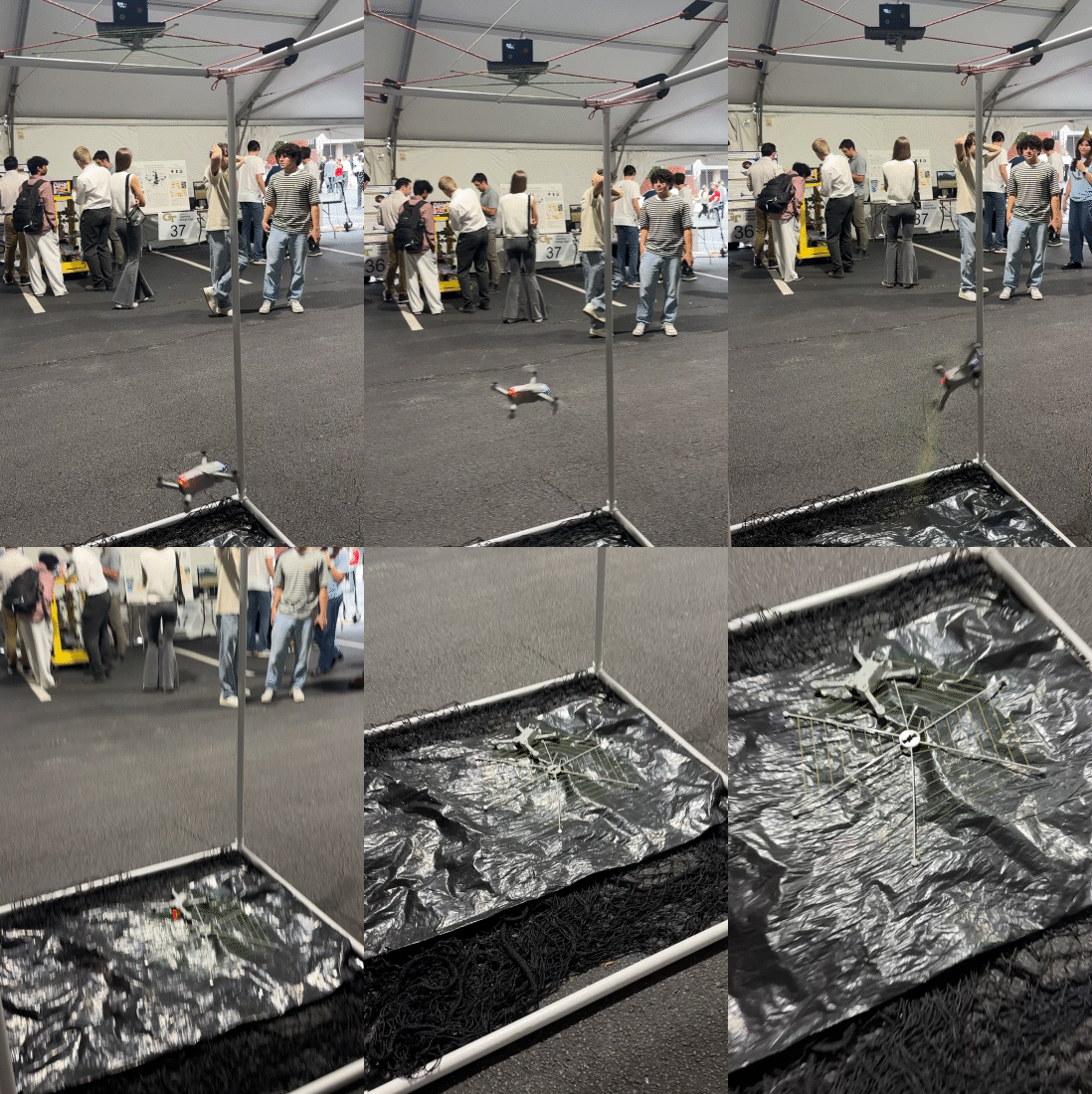
The Air. Space. Denial. team created a defense system that uses drones to drop spiderweb-like nets on unmanned enemy craft, tangling the rotors and downing the machine.
(text and background only visible when logged in)

Team Char Wars evaluated the effectiveness of biochar for removing arsenic from water in Guatemala. This 3D-printed disk is designed to be filled with the charcoal-like substance and inserted into a commonly used filtration system.

The portable Liver ProTECHt device can keep a liver viable during transport between a donor and recipient by cooling but not freezing the organ and supplying it with preservation fluid infused with oxygen.
The other top overall team was Liver, Laugh, Love, a group of biomedical engineers tasked by the Emory Healthcare transplant team with finding a better way to preserve livers during transport between donors and recipients.
Every year, hundreds of patients die waiting for a liver transplant because the organ goes bad before it arrives. That’s because the most common approach is to put the liver on ice to slow its function, but that only keeps it viable for about six hours.
Some hospitals have access to systems that can preserve it for up to 24 hours, but they’re bulky, heavy, and cost tens of thousands of dollars per use.
“This project affects rural communities and low-income hospitals the most. The current systems, because of their exorbitant cost, can’t be adopted across the country,” said team member Shobana Santhanam. “That makes it harder to get organs to people, because many hospital centers aren’t able to use the cutting edge of technology. We wanted to integrate the newest, most novel technologies into a smaller and more affordable system so that it could be adopted across the country.”
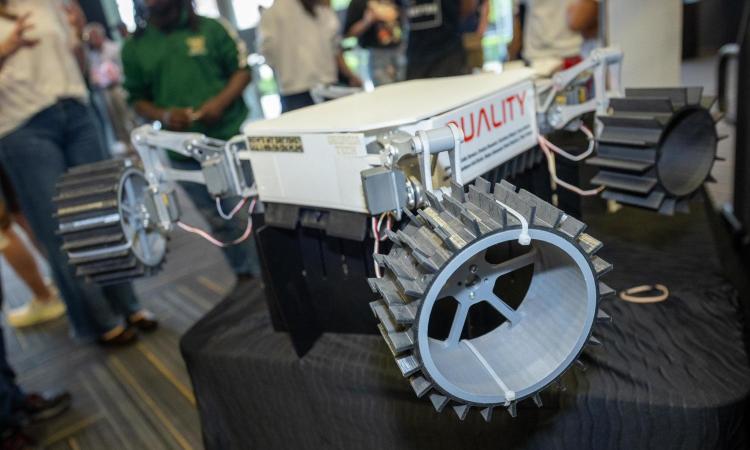
See More Photos
A look at more projects and teams from the spring Expo.
Santhanam said the team’s solution keeps livers at cold, but not freezing, temperatures and maintains a flow of hypothermic preservation fluid that’s also infused with oxygen. Their approach cuts costs by 60% and the device’s size and weight by 80%. Santhanam said Emory’s team plans to continue developing the system.
Further development also was the goal for the best interdisciplinary project. Team Char Wars picked up the work of a previous capstone project that determined using a charcoal-like substance called biochar would be a promising way to filter arsenic out of drinking water in Guatemala.
The team — biomedical, computer, and mechanical engineers — conducted a series of experiments evaluating the material’s effectiveness and designing it to fit a common water-filtration system used in the Central American country.
“In Guatemala, many families already have an existing filter product called the Ecofiltro, which can only filter up to 63% of arsenic,” mechanical engineering student Eli Scott said. “Our goal was to have a design that can easily integrate into the Ecofiltro, while also reducing the arsenic levels in the drinking water as much as possible.”
They found adding biochar to the system reduced their experimental stand-in for arsenic by 25% to 30%.
(text and background only visible when logged in)


Go With the Flow created an indoor, dry-land swimming system designed to replicate the feel and biomechanics of freestyle swimming without water.

Timeless Consulting Solutions assessed the current structural condition (and iconic lattice) of the historic Watson Mill Bridge in Comer, Georgia, then used their findings to fabricate a new bridge for an Atlanta park.

Elsewhere, the top project in electrical and computer engineering was a system for caregivers that detects when someone falls in a room without using cameras or requiring a wearable device. Among aerospace engineering students, judges selected a two-propellant methane-oxygen rocket designed to reach an altitude of 45,000 feet.
Other posters, projects, and prototypes spilled out of McCamish Pavilion and across the adjacent parking lot, including:
- A mattress that’s 40% to 60% lighter.
- A freestyle swimming simulator that operates on dry land.
- A satellite designed to clean up space debris by causing it to fall back to Earth and burn up in the atmosphere.
- A drum kit for drummers with physical impairments that’s easier for one person to set up and tear down.
- An AI-powered golf coach.
- A self-clearing ear tube to prevent blockage and repeat insertion procedures for kids with recurring ear infections.
Students also developed a funding model so the United Way of Greater Atlanta can help more people with housing aid and redesigned processes for the Empty Stocking Fund to deploy school supplies from its Teacher Resource Center to help more Atlanta-area teachers.
The Capstone Design program is supported by philanthropic donations that are part of Transforming Tomorrow: The Campaign for Georgia Tech, a more than $2 billion comprehensive campaign designed to secure resources that will advance the Institute and its impact — on people’s lives, on the way we work together to create innovative solutions, and on our world — for decades to come.
See all the winners from Capstone Expo below and visit expo.gatech.edu for more projects.

InvisiVisor is a car sun visor replacement designed to improve visibility and minimize distractions by automatically darkening specific areas of the visor based on the driver’s eye position.

Ready2Roll retractable training wheels provide stability to children learning to ride a bicycle.

Team Pentatronics’ drum set can be set up quickly from a seated position, ideal for drummers with mobility impairments.
(text and background only visible when logged in)
(text and background only visible when logged in)
Capstone Results
Air. Space. Denial.
OVERALL BEST PROJECT (TIE)
Drone-based defense system against surveillance and attack
- Grayson Benton, ME (Ashburn, VA)
- Nicholas Despain, EE (Conyers, GA)
- Timothy Judson, ME (Acworth, GA)
- Christopher Kirschner, ME (Woodstock, GA)
- Ariel Sauer, EE (Jacksonville, FL)
- Andrew Silver, ME (Warner Robins, GA)
Liver, Laugh, Love
OVERALL BEST PROJECT (TIE)
Cost-effective, portable liver machine perfusion
- Kavya Laghate, BME, (Greenville, SC)
- Brennan Long, BME, (Warner Robins, GA)
- Dhruv Nambiar, BME, (Denver, CO)
- Vibha Narasayya, BME, (Seattle, WA)
- Ritu Rai, BME, (Suwanee, GA)
- Shobana Santhanam, BME, (Suwanee, GA)
Char Wars
INTERDISCIPLINARY
Low-cost arsenic filter for drinking water
- Hunter Bennett, ME (Gainesville, GA)
- Blakely Daws, ME (Kennesaw, GA)
- Jocelyn Heath, ME (Calhoun, GA)
- Isaac Lecompte, BME (Savannah, GA)
- William Moss, CmpE (Conyers, GA)
- Eli Scott, ME (Evans, GA)
MOSES
DANIEL GUGGENHEIM SCHOOL OF AEROSPACE ENGINEERING
Methane-oxygen propelled rocket design
- Jason Abston (Villa Rica, GA)
- Raey Ayalew (Minneapolis, MN)
- Jonathon Barringer (Detroit, MI)
- Dakota Basista (Pittsburgh, PA)
- Anushka Dharmasanam (Ballwin, MO)
- Daniel Elliott (Salt Lake City, UT)
- Jonah Isaza (Atlanta, GA)
- William Putaansuu (Bremerton, WA)
- Drew Wilson (Dripping Springs, TX)
Groupe
SCHOOL OF ARCHITECTURE
Readymade art on the Georgia Tech campus
- Hellen Gonzalez (Miami)
- Ryan Shanahan (Northbrook)
Valsaviors
WALLACE H. COULTER DEPARTMENT OF BIOMEDICAL ENGINEERING
Tool for hypertrophic cardiomyopathy assessment
- Bryant Ingram (Auburn, AL)
- Tzak Lau (Lakeland, FL)
- Spencer Lawing (Texarkana, TX)
- Inho Lee (Daejeon, South Korea)
- Robert Nelson (Kennesaw, GA)
- Krishna Srivatsa (Atlanta, GA)
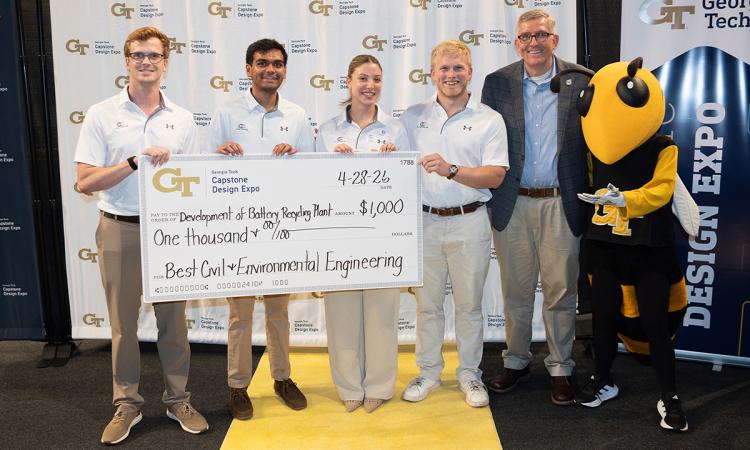
Development of Battery Recycling Plant
SCHOOL OF CIVIL AND ENVIRONMENTAL ENGINEERING
Plant design for lithium-ion battery reclamation
- Paul Baisier (Dunwoody, GA)
- Jessica DaSilva (Miami, FL)
- Nathan Dunagan (Atlanta, GA)
- Anuj Patel (Beaufort, SC)
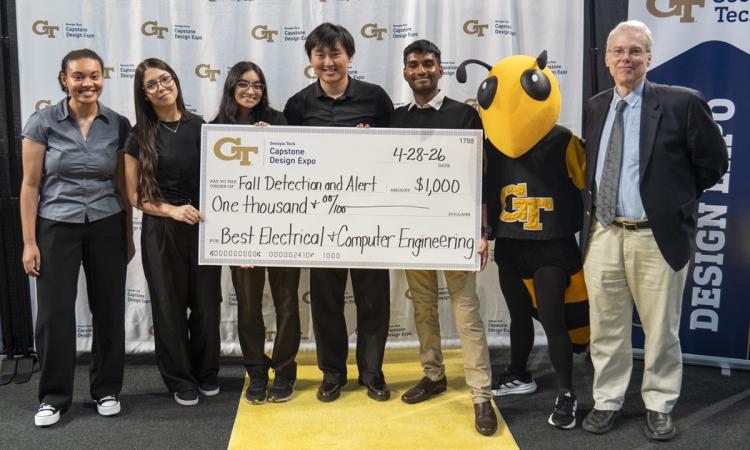
Fall Detection and Alert
SCHOOL OF ELECTRICAL AND COMPUTER ENGINEERING
A noninvasive sensor solution to detect falls
- Arushi Chauhan, EE (Bartlett, IL)
- Srijith Hariharan, CmpE (Bangalore)
- Kellen Nie, CmpE (Boise, ID)
- Gabriella Reese, EE (Gray, GA)
- Livia Santos Brito, EE (Kennesaw, GA)
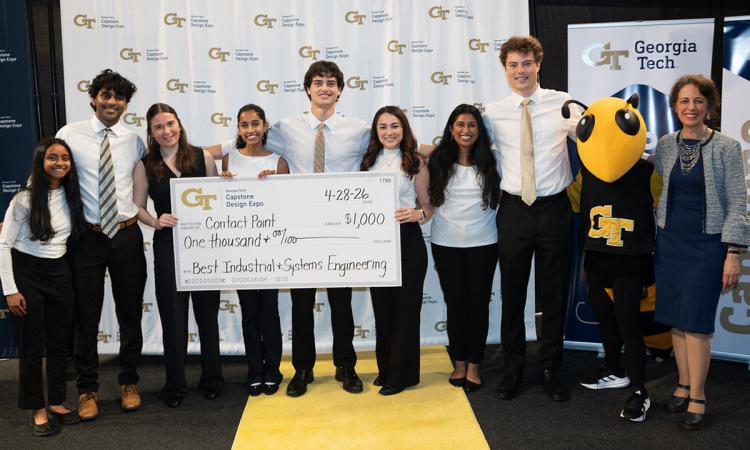
Contact Point
H. MILTON STEWART SCHOOL OF INDUSTRIAL AND SYSTEMS ENGINEERING
Standardized kitting process for Elevate Solutions Group
- Saba Ansari (Atlanta, GA)
- Justin Collins (Calgary, Canada)
- Pardha Kanchiraju (Alpharetta, GA)
- Skyler Malmberg (Jupiter, FL)
- Hannah Mathew (Lilburn, GA)
- Visakhi Miriyapalli (Monroe, NY)
- Nick Nist (Jacksonville, FL)
- Esha Pentakota (Alpharetta, GA)
Eye Soar
INDUSTRIAL DESIGN AND ENGINEERING
Self-adjusting eyewear for children in Guatemala
- Hannah Clay, MSE (Statesboro)
- Miller DeVane, BME (LaGrange)
- Madison McPeters, ID (Tyrone)
- Roberto Ponte, ID (Atlanta)
- Marissa Reichelscheimer, MSE (Melville, NY)
- Luke Rendel, ME (Las Vegas)
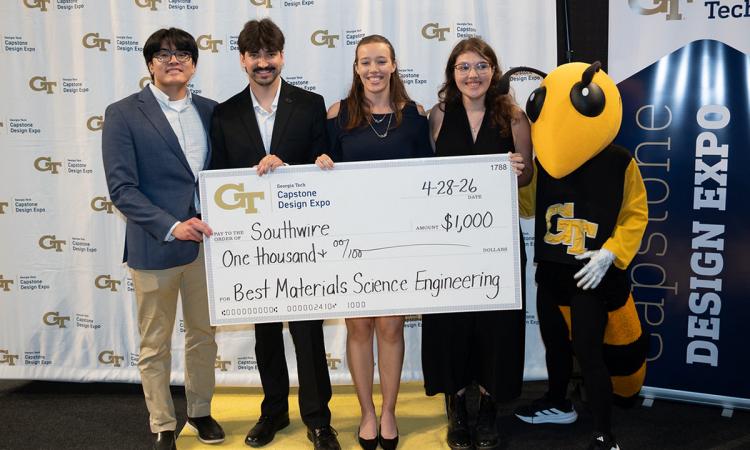
Southwire
SCHOOL OF MATERIALS SCIENCE AND ENGINEERING
Metering pin for Southwire casting process
- Ella Parker (Austin, TX)
- Sean Phillips (Kathleen, GA)
- Sean Santos (Olney, MD)
- Gabriella Ward (Bethesda, MD)
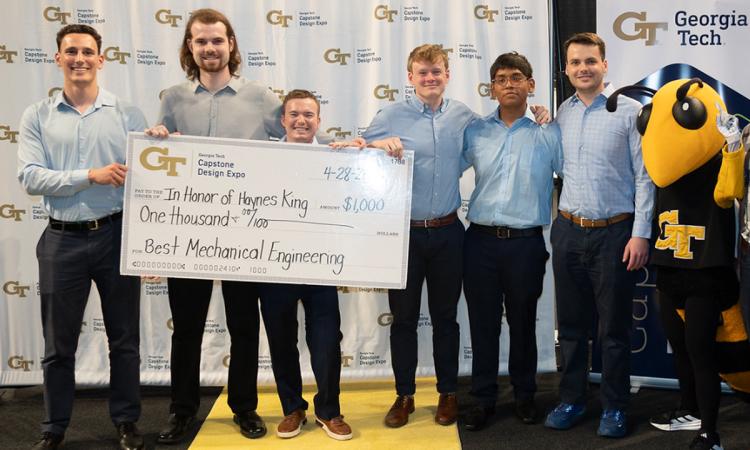
In Honor of Haynes King
GEORGE W. WOODRUFF SCHOOL OF MECHANICAL ENGINEERING
Low power agitation system for water heaters
- Joseph Asto (Lawrenceville, GA)
- Daniel Bailey (Buford, GA)
- Matthew Bell (Atlanta, GA)
- Andrei Khazatsky (New York City, NY)
- Kuiper Roerdink (Rising Fawn, GA)
- Charles Whitener (Chattanooga, TN)
Gone Fission
NUCLEAR AND RADIOLOGICAL ENGINEERING
A deep borehole nuclear reactor analysis
- Kendal Chunn (Mt. Pleasant, SC)
- Colin Gold (Pensacola, FL)
- Derek Lewis (Oakton, VA)
CommuniCare
SCHOOL OF PUBLIC POLICY
Language interpretation gaps in rural Georgia healthcare clinics
- LillyAnne Beatty (Fayetteville, GA)
- Alison Eltz (Woodstock, GA)
- Hunter Manning (Vidalia, GA)
- Luis Salazar (Lawrenceville, GA)
- Kyra Stillwagon (Savannah, GA)
- Esha Venkat (Ashburn, VA)
Honorable Mentions
- Kidney Krew, BME
- MindFrame, BME
- Mini Mechanics, Interdisciplinary
- OpenForge, Interdisciplinary
- Rumbling Gamblers, Interdisciplinary
- Safety Innovations, Interdisciplinary
- Sidewalk Sidekick, Interdisciplinary
- SiteSense, CEE
(text and background only visible when logged in)
(text and background only visible when logged in)
Related Stories
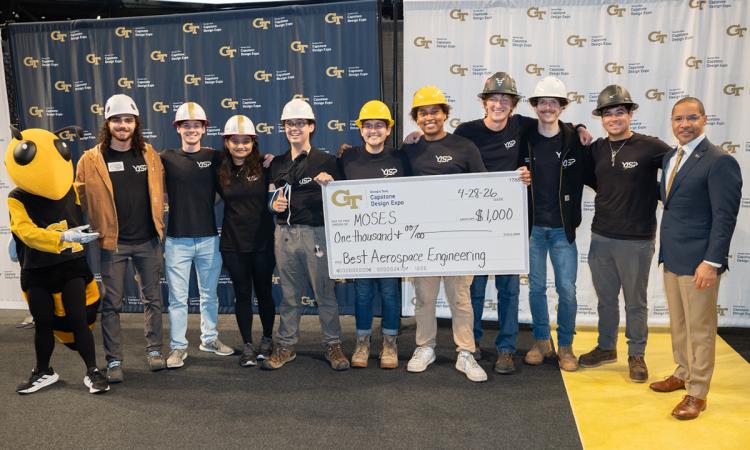
Team M.O.S.E.S. Wins the Top Aerospace Spot at Capstone Expo
The team built the largest collegiate liquid rocket launch rail in the country for a two-propellant methane-oxygen rocket.
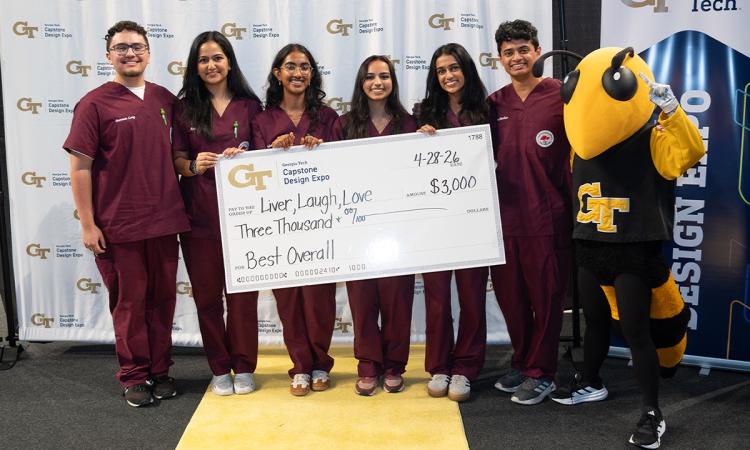
BME Wins Best Overall for Sixth Consecutive Semester
A device that could improve the quantity and quality of donated organs for transplant patients took top honors at the Capstone Design Expo.
Record Number of CEE Teams at Spring Capstone Design Expo
The CivCore Consulting team took home the top CEE prize with their plan to develop a battery recycling plant.
Fall Detection and Alert Wins Top ECE Award
ECE students also contributed to the Best Interdisciplinary and Best Overall Project Award winners.
Contact Point Wins ISyE Prize
The team optimized and standardized the kitting process for a contact lens provider.
Woodruff School Teams Shine at Capstone Design Expo
The winning ME team addressed temperature stratification in water heaters, and the top NRE team evaluated a novel nuclear microreactor concept.
MSE Innovation Shines at Spring Expo
MSE students tackled projects with oversized American flags, mattress materials, car tires, and more.
(text and background only visible when logged in)