
The annual competition seeds student ideas that use engineering principles to improve access and community across Georgia Tech.
(text and background only visible when logged in)

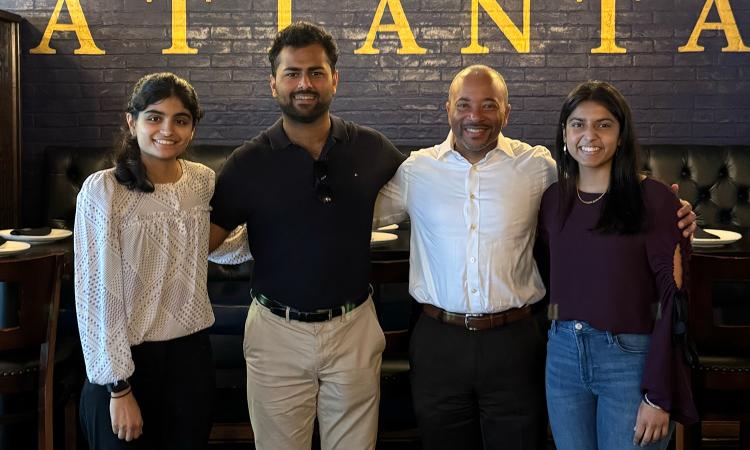
FAIR Tech winners, from left: Janiya Richardson, Ignacio Montoya, Ayomide Samson Oluwajoba and Taofik Ahmed Suleiman.
For the first time in its six years, two projects tied for first place in the College of Engineering FAIR Tech competition. Both focused on improving navigation and accessibility across the Georgia Tech campus.
Janiya Richardson’s project is rooted in the present. She developed a system to help visually impaired students traverse the constantly changing campus landscape. It pairs a smart walking cane with a head-worn camera and headphones to provide users with a complete environmental picture.
Ignacio Montoya’s idea looks to a future where exoskeletons and robotic mobility devices will help users interact with their environment. His goal was to understand what accessibility looks like when robotic mobility assistance moves from the lab to real-world use.
Meanwhile, Ayomide Samson Oluwajoba and Taofik Ahmed Suleiman won third prize for creating an event series to help students share their cultures with each other. The team wanted to evolve cross-cultural experiences from brief passing interactions to something more intentional.
FAIR Tech — Fostering Access & Innovation 'Round Tech — aims to inspire students to use engineering principles to create a fairer community on campus. Finalists receive $1,000 to prototype and pilot their innovations. Judges then rank the top three teams and award cash prizes.
(text and background only visible when logged in)
First Place: An ‘All-Knowing’ Campus Nav System
Richardson calls her navigation system Odin. It includes an existing smart cane prototype, a lightweight head-worn camera and Bluetooth headphones that clip onto glasses, and a waistbelt with a computer and battery. Paired with a custom smartphone app, they can detect overhead obstacles, read signage, and provide audio cues to help users get around.
“Navigating campus presents hazardous situations for students with visual impairments. Constant construction, crowded walkways, and complex indoor spaces create barriers that traditional assistive technologies cannot fully address,” said Richardson, who’s entering the final year of her computer engineering and computer science studies. “These barriers directly impact a student’s sense of belonging and equal access.”
Richardson recruited students through the Office of Disability Services to test her system and offer feedback. She’s planning more guided field trials on campus and wants to apply to CREATE-X Startup Launch in the fall.
Richardson said the FAIR Tech competition gave her experience as a project manager and engineer. It also required her to manage a budget and ensure her solution was cost effective. And while she appreciated winning, she valued the opportunity to create a real-world solution more.
“Participating and presenting in the competition was really the true prize for me, because I was able to finally to take an idea from my notebook and make it exist in real life,” she said. “No student should be discouraged from playing an active role in the school because of navigation barriers.”
(text and background only visible when logged in)

(text and background only visible when logged in)
First Place: Assessing Real-World Robotic Mobility

The other first-place winner brought different ideas about campus accessibility to the competition.
Montoya is a biomedical engineering Ph.D. student who injured his spinal cord in a motorcycle accident when he was a Georgia Tech undergrad. His FAIR Tech project established a foundation for two concepts. One is an index measuring how well users of robotic mobility devices can navigate an environment. The other would be a designated, optimized corridor designed specifically to help people using exoskeletons or similar assistance.
“Most accessibility systems were designed primarily around seated mobility and wheelchair navigation. Wearable robotic mobility systems introduce very different movement mechanics, balance requirements, turning radii, gait timing, surface sensitivities, and energy demands,” Montoya said. “My goal was to better understand what accessibility looks like when robotic mobility moves beyond the clinic and into everyday environments while also exploring how these systems could support long-term rehabilitation and health outside traditional care models.”
Montoya’s pilot involved him donning a Wandercraft EVE self-balancing personal exoskeleton and walking across campus, independently navigating paths and building entrances. As part of the trial, he purchased a beverage at the Student Center, worked at a standing desk, and squatted to reach items on low shelves.
“Real-world environments introduce variability, unpredictability, and sensory demands that cannot be fully replicated inside controlled laboratory settings,” Montoya said. He thinks Georgia Tech is positioned to be a leader in ensuring access that accounts for emerging technologies in neuroscience and robotic assistance while leading the evolution of accessibility standards to include new kinds of devices and systems.
FAIR Tech offered Montoya the opportunity to move beyond theoretical considerations to actually try advanced systems in real-time. He said he hopes his work will help accelerate the transition from isolated research systems to scalable technologies available for people to use — and help communities evolve to accommodate these technologies so users can expand their recovery into everyday life.
The project is part of long-term work Montoya has been involved in at the University of California, Los Angeles, and now as part of his Ph.D. work in Cassie Mitchell’s research group. It’s also personally meaningful: Montoya is a researcher and a participant, logging more than 655 miles on a treadmill and a million steps in exoskeleton devices.
“Thirteen years ago, Georgia Tech was the last place I walked before my spinal cord injury,” he said. “Returning years later as a Ph.D. student and walking across the same campus again in an exoskeleton made this work feel deeply personal and scientific.”
(text and background only visible when logged in)
(text and background only visible when logged in)
Third Place: Jollof to Sushi
For their project, biomedical engineering Ph.D. students Oluwajoba and Suleiman suggested boosting belonging and connection on campus by providing more structured opportunities for students to explore and participate in different cultural traditions.
They proposed a regular showcase to highlight different cultures led by engineering students from that culture. The events would offer a standard structure: storytelling, music, and dance; food tasting; and guided discussion. They called their idea Jollof to Sushi, naming it after traditional African rice and the Japanese staple, and ran a pilot in the spring focused on the 16 countries of West Africa.
“The strong participation and feedback we received showed that students are not only engaged but eager for more, giving us a clear path to scale this into a community-driven model across Georgia Tech,” Suleiman said. “We saw clear evidence that students are genuinely interested in learning about other cultures, and Jollof to Sushi provides a structured and engaging platform for that kind of intercultural exchange.”
Their event attracted 54 students from more than 10 countries and a range of majors. More than 95% rated the experience positively. Now Suleiman and Oluwajoba are working to partner with other student organizations and expand to the Caribbean, Asia, and beyond.
They said they’ve built a repeatable event framework that makes it easy to do more — with important benefits beyond engaging students in broadening their cultural horizons.

Oluwajoba and Suleiman
“Research and campus climate studies consistently demonstrate that a strong sense of belonging is closely linked to student retention, academic success, and mental well-being,” Oluwajoba said. “The FAIR Tech competition helped us turn an idea into a structured, data-driven pilot. It pushed us to think like engineers, designing the initiative as a system with clear goals, measurable outcomes, and scalability.”
(text and background only visible when logged in)

(text and background only visible when logged in)
Related Content
Summer Storage Solution Wins College’s 2025 FAIR Tech Competition
The competition asks students to use engineering fundamentals to create solutions that improve the experience for all students in the College community.
The competition asks students to use engineering fundamentals to create solutions that improve the experience for all students in the College community.
International Student Support, Menstrual Products Map Win College’s FAIR Tech Innovation Competition
The competition asks students to use engineering fundamentals to create solutions that promote equity and access in the College community.
The competition asks students to use engineering fundamentals to create solutions that promote equity and access in the College community.