
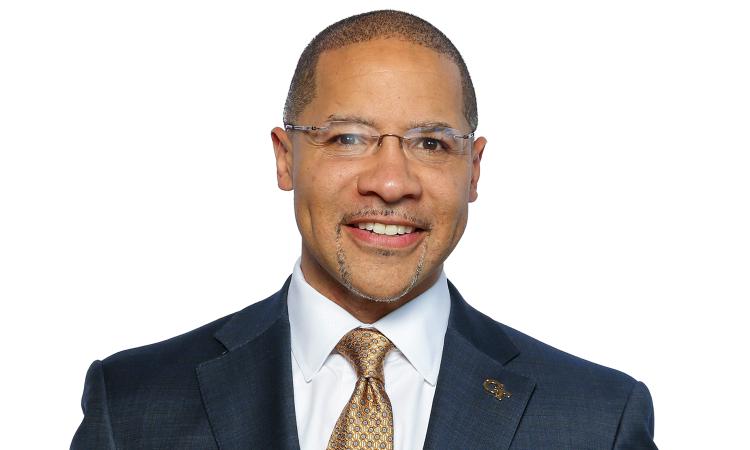
With two months in the job, Dean Mitchell Walker talks about opportunities and challenges and how he’s tapping the College to help craft a vision for the future.
(text and background only visible when logged in)

(text and background only visible when logged in)
Mitchell Walker became the 13th permanent dean of the College of Engineering in June, capping more than 20 years at Tech as a researcher, teacher, and leader at Georgia Tech.
As his first academic year leading the College gets started, the Southern Company Chair shared some of his early priorities and the surprises of taking on a new role at a place that’s so familiar.
What are the biggest opportunities you see for the College in the next few years?
We’re living through a unique moment in engineering and higher ed, particularly because of artificial intelligence. Georgia Tech is already leading in how AI is incorporated into teaching and learning, whether through initiatives like the AI Makerspace, our Minor in Applications of Artificial Intelligence and Machine Learning, or the work being done to reimagine courses with AI in mind. We must continue to expand on AI in our curriculum so our students graduate prepared to lead in an AI-integrated world — not just how to use it.
Another major opportunity is defining the next generation of experiential learning. Our College has long been a leader through programs such as Vertically Integrated Projects, Capstone Design, CREATE-X, and study abroad, but there’s an opportunity to go even further in preparing students through hands-on experiences that connect classroom learning to real-world challenges.
We’re also focused on strengthening partnerships with industry to accelerate the translation of research into products, technologies, and solutions that improve lives. We need to be more intentional to demonstrate that the work we do directly impacts people’s lives.
Finally, we must continue to strengthen our support of Georgia and its citizens. As a state-funded university, we have the responsibility to support and strengthen the economic prosperity of Georgia by helping create jobs, support innovation, and strengthen communities.
(text and background only visible when logged in)
You talked extensively during the interview process about building a vision for the College together. How are you starting that process?
One of my first priorities as dean is launching a 90-day listening and learning tour. Over the next few months, I will meet with students, faculty, staff, college leadership, partners across campus, members of our alumni board, industry leaders, and other stakeholders to better understand the College’s strengths, challenges, and opportunities.
The themes that emerge from those discussions will be part of the College’s next strategic planning process, which we will launch this fall. I believe our future direction should be informed by the people who know the College best and are deeply invested in its success. We will develop that vision collaboratively; the goal is to share the plan in the spring.

When families entrust us with their students, we help develop the knowledge, skills, and mindset that allow them to make meaningful contributions in the world. It’s a responsibility we take seriously.
What is the one thing students and alumni should know about you?
My personal passion is helping students achieve their goals. If a student comes to Georgia Tech willing to do the work, I want us to help them get wherever they want to go next, whether that’s becoming an astronaut, launching a startup, advancing self-driving technologies, or pursuing a career as a professor.
That commitment is reflected in our investments inside and outside the classroom, from co-ops and internships to makerspaces, CREATE-X, and other experiential learning opportunities. We want every student to have the support and opportunities to succeed.
For alumni, I want them to know how proud I am of what they’ve accomplished. Georgia Tech’s reputation is built on the education we provide and research we conduct. But the greatest measure of Tech’s impact is what our graduates do after they leave. Their achievements and the difference they make in their professions and communities are the most powerful expression of what Georgia Tech represents.
(text and background only visible when logged in)
Why did you become an engineer?
My interest started with engines and the idea of building things that move people and perform useful work. I didn’t grow up knowing any engineers personally, but my teachers and others during high school encouraged me to explore engineering as a career.
Aerospace engineering stood out because it involved some of the most fascinating technologies, from aircraft to rockets to advanced propulsion systems. I initially wanted to be a pilot but was quickly drawn toward understanding how airplanes work and how they’re designed. That curiosity eventually led to a career focused on creating and advancing technology rather than operating it.
I’ve always thought engineering can feel like a superpower. Engineers can predict how a bridge will perform, how fast a vehicle will travel, or how a system will behave decades into the future. We use science and mathematics to make those predictions and then turn ideas into reality.
That’s also what excites me about engineering education. When families entrust us with their students, we help develop the knowledge, skills, and mindset that allow them to make meaningful contributions in the world. It’s a responsibility we take seriously.
(text and background only visible when logged in)
What has surprised you in your first few months as dean?
One lesson I’ve carried with me from my first days as an undergraduate student is the importance of shifting from trying to prove what you know to focusing on what you have yet to learn.
As a student, real growth began when I became comfortable admitting what I didn’t know and asking questions. The same principle applies to this role.
One of the most important things I’m learning as dean is to resist assuming that I already understand a situation. Instead, I try to stop, ask questions, and genuinely seek to understand. Phrases like “help me understand” are incredibly valuable, because they create opportunities to learn from others and make better decisions.
That mindset has been one of the most rewarding parts of the transition so far.
(text and background only visible when logged in)
Related Content
Mitchell Walker Named Dean of College of Engineering
Walker will begin his new role on June 15 after leading the nation’s top-ranked public aerospace program since 2024.
Walker will begin his new role on June 15 after leading the nation’s top-ranked public aerospace program since 2024.