
The grants are the National Science Foundation’s most prestigious funding for early career professors.
(text and background only visible when logged in)
Eight faculty members in the College of Engineering have received sought-after support from the National Science Foundation (NSF) to help them establish their research portfolios.
The agency’s Faculty Early Career Development Awards are highly competitive, five-year grants designed to help promising scholars build the foundation for a lifetime of leadership in their fields. Known as CAREER awards, the funding is targeted to faculty members who have the potential to serve as role models in research and education.
Altogether, NSF gave CAREERs to 15 Georgia Tech faculty members.
Meet the 2026 recipients in engineering:

John Blazeck
Associate Professor, Cecil J. "Pete" Silas Faculty Fellow
School of Chemical and Biomolecular Engineering
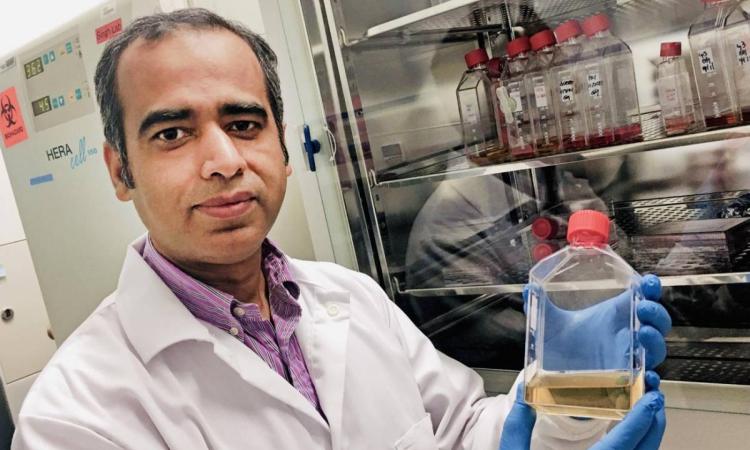
Blazeck’s project focuses on creating and evolving antibodies from yeast to offer new ways to study the process and explore the function of these key immune system proteins.
In people, the immune system’s B cells produce antibodies to help fight disease, but the process takes months. Blazeck said that means it’s difficult for researchers to study how antibodies arise and evolve.
“The results of the project will provide insights into the formulation of more effective disease-targeting therapeutics,” he said. “The project also will support course development and the creation of educational apps to train students in synthetic biology and biotechnology.”
Lauren Garten
Assistant Professor
School of Materials Science and Engineering
Garten will work to design a new class of semiconducting ferroelectric materials that efficiently generate and direct electrical charges. Ferroelectrics are unique materials with a built-in electric field that can be reversed. Garten’s goal is to systematically fine tune the crystal structure, electric field, and light absorption of a specific semiconducting ferroelectric.
Understanding the physics that drive the process of generating current in the materials will lay the foundation for new kinds of ferroelectric transistors, medical sensors, solar cells, computer memory, and more.


Suhas Jain
Assistant Professor
George W. Woodruff School of Mechanical Engineering
Jain’s CAREER will study the complex interactions between liquids and gases. These gas-liquid flows are notoriously difficult to predict, though they show up throughout nature and in engineered systems, including in ocean waves and gas exchange in human lungs. They’re also found in chemical reactors and combustion devices.
Jain and his team will use powerful supercomputers and a simulation framework they’ve developed to investigate how the interfaces separating liquids and gases stretch, wrinkle, break apart, and reconnect. The goal is to offer new capabilities in predicting these behaviors.
"Ultimately, better models enable better engineering decisions while reducing the need for costly trial-and-error experimentation," Jain said. “The ability to accurately predict multiphase flows remains one of the grand challenges in fluid mechanics, and addressing that challenge has the potential to impact many sectors of society.”
Aditya Kumar
Assistant Professor
School of Civil and Environmental Engineering
Kumar also will build new computer models to improve predictions, but his will focus on understanding how the internal structure of composite materials results in fractures and failures.
Composites are made of two or more materials combined at the microscopic scale to improve properties such as stiffness, strength, and toughness. Predicting how the arrangement and properties of the base materials ultimately govern the behavior of the overall composite remains a challenge.
Engineers have long relied on a trial-and-error cycle of extensive testing and redesign. Kumar is working to develop a more predictive approach.
“This project aims to build new mathematical and computational models that accurately connect what happens at the microscopic level to the overall strength and fracture resistance of the material,” Kumar said. “We want to understand how the ‘recipe’ of a composite material determines how it breaks. That understanding could eventually help engineers design tougher, more reliable composites with greater confidence.”


Divya Mahajan
Sutterfield Family Assistant Professor
School of Electrical and Computer Engineering
Mahajan’s research will focus on an issue confronting many communities across Georgia and the U.S.: the energy needs of artificial intelligence data centers. She’s working to design energy efficient, adaptive data centers through an approach that jointly considers AI software, computing hardware, and the physical operating conditions.
More powerful AI models place increasing demands on every layer of data centers — accelerators, memory, networking, power delivery, cooling, security and more. Typically, these systems are designed and optimized individually, which limits the center’s overall efficiency and adaptability.
Mahajan’s research reimagines data centers as cyber-physical systems where each of these layers continuously informs one another.
“AI infrastructure should be designed around the real-time condition of the hardware, not just its specifications,” Mahajan said. “By making AI systems aware of the physical state of the infrastructure, we can build data centers that are more efficient, adaptive, and resilient at scale.”
Da Pan
Carlton S. Wilder Assistant Professor
School of Civil and Environmental Engineering
Pan aims to create a more complete and less expensive network for monitoring nitrogen exchange in the air across larger regions.
Nitrogen enters the atmosphere from agricultural use and combustion in the form of compounds that can contribute to air pollution and ozone formation. Yet scientists don’t have enough measurements to accurately understand where nitrogen compounds come from, how they travel, and where they end up, Pan said.
He will develop a tiered monitoring framework combining machine learning and a variety of data sources — direct measurement at “super sites” with many instruments, lower-cost measurement from other locations, satellite data, existing air quality observations, and atmospheric models.
“Ultimately, the work aims to contribute to strategies that maintain agricultural and industrial productivity while reducing harmful nitrogen losses to the atmosphere and ecosystems,” Pan said.


Sung Jin Park
Assistant Professor
Wallace H. Coulter Department of Biomedical Engineering
Park aims to pair bioprinting and subtractive tissue engineering — selectively removing cells to shape tissues — to create a biomanufacturing platform that enables realistic disease models and new tissue regeneration strategies.
Using patterned light, Park will induce the body’s natural process for eliminating cells to shape tissues and organs without affecting neighboring cells. His team will test their technique in lab models of heart and liver tissue with the goal of studying how immune cells clean up dying cells to support healing, modeling scar formation, and opening channels for blood flow.
Emily Sanders
Assistant Professor
George W. Woodruff School of Mechanical Engineering
Sanders will study interlocking granular materials that can be both soft and rigid, depending on how they’re manipulated.
Her goal is to better understand how the materials deform and fail. With that understanding, she will develop computer models to help engineers design structures with the materials that have tunable mechanical properties and even shape-shifting abilities.
“Such a material system has very low stiffness, with almost fluid-like behavior at low deformation, but becomes very stiff as deformation increases in extension or contraction,” Sanders said. “Thus, their mechanical response can be tuned based on the level of deformation, so that properties can be managed in real time.”
Sanders imagines the work could open new possibilities for soft robotics, electronics, and advanced manufacturing.

Related Content

Better, Not Just Bigger
The massive computing facilities popping up across the country have become notorious for requiring huge resources. These engineers are thinking about how data centers can be more efficient and how they influence our future power needs.
The massive computing facilities popping up across the country have become notorious for requiring huge resources. These engineers are thinking about how data centers can be more efficient and how they influence our future power needs.
Cancer Fighters
Engineers are rewiring cells and creating new tools to improve cancer therapies and catch the disease earlier.
Engineers are rewiring cells and creating new tools to improve cancer therapies and catch the disease earlier.