
Students will earn a master’s in robotics from Tech alongside their medical degree from Emory in one of the first programs of its kind in the U.S.
(text and background only visible when logged in)
Georgia Tech is partnering with the Emory University School of Medicine to create a new dual-degree program for future doctors with an interest in robotics.
The five-year program pairs an Emory Doctor of Medicine degree with a Georgia Tech Master of Science in Robotics. Together, they will provide a new generation of physicians with the clinical knowledge to identify opportunities in health and medicine and the engineering background to design solutions using robotics and artificial intelligence (AI).
Aimed at students with backgrounds in engineering, robotics, or computer science, the program capitalizes on existing strong ties between Tech and Emory to create a program that’s the first of its kind in the nation.
“This is a truly interdisciplinary dual-degree program that enables future clinicians to have a strong foundational understanding of robotics and artificial intelligence so that they are better informed and educated as they encounter and use new technologies in their profession,” said Jaydev P. Desai, a biomedical roboticist, Cardiovascular Biomedical Engineering Distinguished Chair in the Wallace H. Coulter Department of Biomedical Engineering at Georgia Tech and Emory, and one of the chief architects of the program.
About the M.D./M.S. Robotics Program
- Five-year dual-degree
- Apply through the Emory School of Medicine
- First year at Georgia Tech, then four years at Emory
- MS Robotics Program of Study
- Begins Fall 2027
The program will accept its first class in Fall 2027. Program leaders expect four to six students each year. Students will apply as medical students through Emory and indicate interest in the MD/MS Robotics pathway.
Once admitted, they’ll spend the first year at Georgia Tech completing robotics coursework in mechanics, controls, perception, AI, human-robot interaction and more. Then they’ll shift to Emory for four years of medical school. Students will continue to work on the master’s program requirements, including an internship and capstone project.
“Robotics is having significant impact in patient care, including in a growing number of minimally invasive surgeries that cause less tissue damage and allow patients to go home sooner,” said Alyssa Panitch, professor and Wallace H. Coulter Department Chair of Coulter BME. “We need physician innovators to help ensure we bring the best possible new robotic technologies into the clinic to continue to improve human health.”
(text and background only visible when logged in)
This is a truly interdisciplinary dual-degree program that enables future clinicians to have a strong foundational understanding of robotics and artificial intelligence so that they are better informed and educated as they encounter and use new technologies in their profession.
JAYDEV DESAI
Cardiovascular Biomedical Engineering Distinguished Chair

The dual MD/MS Robotics program expands Georgia Tech’s existing master’s in robotics. Launched five years ago, it was intended to welcome students from a variety of backgrounds who could take robotics into many different fields.
“The MD/MS collaboration with Emory is an exciting and unique realization of that vision,” said Nader Sadegh, associate professor in the George W. Woodruff School of Mechanical Engineering at Georgia Tech and former director of the robotics graduate program. “By educating students both as physicians and as roboticists, we are preparing a new generation of leaders who will not simply adopt emerging technologies but will play a key role in advancing them.”
Program leaders said students who earn both degrees will be well positioned for careers as physician-scientists in academic roles; medical researchers focused on robotics, AI, or technology-enabled care; or leaders in companies focused on surgical robotics, medical devices, and health technology. Graduates also will be equipped to found new ventures around medical devices and robotics or act as innovators within health systems.
“This program is about training physicians who can identify the clinical problems that matter most and also have the engineering background to help build the solutions,” said Jason Bariteau, a professor in Emory’s Department of Orthopaedics who is helping lead the new pathway. “We are not simply adding a technical degree onto a medical degree. We are preparing a new kind of physician-leader for healthcare technology.”
Panitch said the program fits perfectly into the Coulter Department’s efforts to connect engineering solutions to emerging needs in medicine and healthcare.
“One of our missions is to build on the strengths of our existing faculty who work in biomedical robotics,” Panitch said. “Strong links to educational programs like this and to the clinic help us continue to reinforce that while we work to improve student learning and impact human health.”
Related Content

Researchers Create Faster, Cheaper Way to Teach a Humanoid Robot to Walk Over Real-World Terrain
An ME and CSE team developed a more efficient machine learning method to train robotic controllers, deploying it on a two-legged robot that successfully navigated gravel, grass, hills, and more.
An ME and CSE team developed a more efficient machine learning method to train robotic controllers, deploying it on a two-legged robot that successfully navigated gravel, grass, hills, and more.
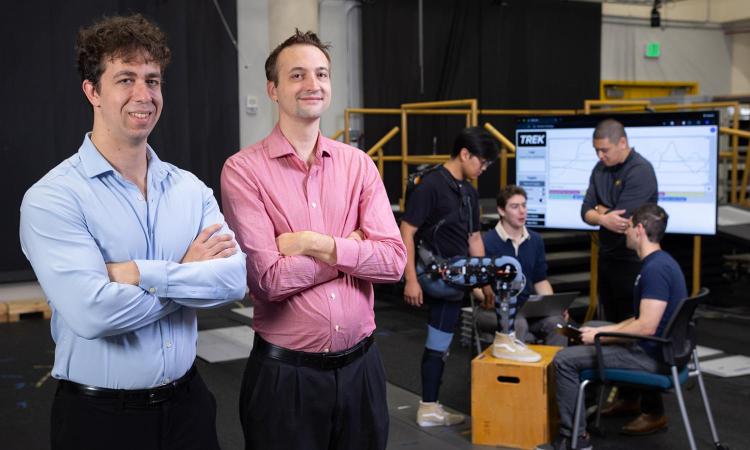
Real-World Helper Exoskeletons Just Got Closer to Reality
Georgia Tech researchers are using AI to quickly train exoskeleton devices, making it much more practical to develop, improve, and ultimately deploy wearable robots for people with impaired mobility.
Georgia Tech researchers are using AI to quickly train exoskeleton devices, making it much more practical to develop, improve, and ultimately deploy wearable robots for people with impaired mobility.