
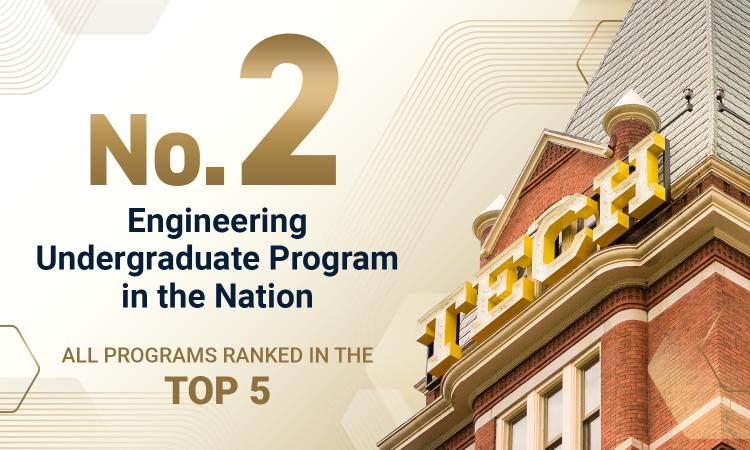
This fall’s total is more than 10,300, capping a stretch of considerable and steady growth for the No. 2 ranked program in the nation.
(text and background only visible when logged in)
For the first time in its history, the College of Engineering has enrolled more than 10,000 undergraduate students. This fall’s total is more than 10,300, a 9% increase from a year ago.
The milestone caps a stretch of considerable and steady growth for the College: The number of undergraduates was less than 8,000 in 2022-23. The increase also arrives as demand for engineers continues to climb across Georgia and the nation.
“Our nation’s future depends on engineers who can turn bold ideas into solutions that improve lives and strengthen our economy,” said Mitchell Walker, dean of the College and Southern Company Chair. “As the College grows, we have an opportunity and the responsibility to prepare more students to meet that need through a rigorous engineering education that includes hands-on experience.”
The College already enrolls more engineering students than any institution of its kind, with this fall’s total enrollment of 22,412 across undergraduate and graduate programs. Each of the College’s 21 programs is ranked within the top 10 by U.S. News & World Report. Overall, the undergraduate degree program is No. 2 in the nation. The graduate program ranks fourth.
Engineering accounted for 5,700 degrees in the 2025-26 academic year, or 40% of all diplomas Georgia Tech awarded.


Meeting a Growing Demand
The growth in enrollment comes amid an increased demand for engineering talent. The Bureau of Labor Statistics projects that employment in architecture and engineering occupations will grow much faster than the average for all occupations through 2035, with roughly 174,800 openings each year. The median annual wage for those jobs was $99,520 in May 2025, nearly double the median across all occupations.
Artificial intelligence has intensified that demand rather than displacing it. Through its AI for Engineering initiative, the College has built AI into the undergraduate curriculum. Graduates now leave Georgia Tech with both a foundation in engineering fundamentals and fluency in AI methods. More than a dozen AI courses have been created or reimagined for undergraduates, and students can pursue an interdisciplinary minor in the applications of artificial intelligence and machine learning.
Engineering students also get access to hardware that is rare outside of national labs and large technology companies. The AI Makerspace is the only supercomputing hub in the country used exclusively for teaching about AI. It provides undergraduates the chance to work at-scale engineering problems rather than reading about them.
“AI is changing not only the engineering profession, but also how students approach engineering,” said Matthieu Bloch, the College’s associate dean for Academic Affairs. “We are embedding AI into our courses without compromising the acquisition of foundational knowledge, enabling students to apply what they learn to larger, more complex real-world problems.”

True to its Public Mission
Georgia resident engineering applicants were admitted at a rate of 33% for Fall 2026, compared with 7% for nonresidents. This year’s enrolling first-year students come from 87 of Georgia’s counties, alongside 48 states and 87 countries.
The return on that commitment is measurable.
Georgia Tech has been named the best value public college by The Princeton Review for the past four years. The Institute earned the top spot in the public school rankings, based on 40 metrics that measure academics, affordability, and career outcomes, as well as survey data from administrators at over 650 schools.
“Being recognized for value reflects what we work toward every day: pairing an exceptional engineering education with opportunities that prepare students to make an impact after graduation,” Walker said. “We want talented students from Georgia and around the world to see Georgia Tech as a place where their investment in education can open doors and help them build a future.”
(text and background only visible when logged in)
Related Content
Undergrad Engineering Reaches No. 2 in 2027 US News Rankings
The College climbs to its highest position in history and remains tied as the top public program. Industrial, civil, and environmental engineering rank No. 1.
The College climbs to its highest position in history and remains tied as the top public program. Industrial, civil, and environmental engineering rank No. 1.
Georgia Tech Climbs to No. 2 University in Federally Sponsored Research Expenditures
It's the highest-ever ranking for Tech, which remains the top university for federal research spending among those without a medical school.
Georgia Tech Research News
It's the highest-ever ranking for Tech, which remains the top university for federal research spending among those without a medical school.