
Lauren Stewart’s work on blast engineering and structural resilience is a fertile place for officers to prepare for military leadership or the next chapter of their civilian lives.

Benjamin Janssen, Libby McCarriston, and Caleb Pym are among the active-duty military members and veterans currently working in Lauren Stewart's civil engineering lab, where researchers use blast simulation and ballistics testing to study how structures respond to explosive forces and projectiles. Master's students Janssen and Pym, left to right in foreground, are officers in the U.S. Air Force. McCarriston is earning her master's after serving five years in the Army.
Failure is a way of life in a research lab. Ideas that don’t work lead to ones that do. And every failure has important lessons for future projects.
It’s different than the military, where failure often isn’t an option. Georgia Tech civil engineer Lauren Stewart learned about that difference early in her career.
She recalls an experiment with her first two graduate students, who were Army officers. After months of preparation, nothing in the tests worked the way they had expected. It was a setback, and one student took it hard.
“I wasn’t a big deal to me at all. I said, ‘Don’t worry about it. It’s fine.’ And he said, ‘In my world, if I fail, people die,’” Stewart said.
“It’s stuck with me ever since. I have taken it to heart with every other student because it made me understand how different his experience was. And that’s part of how I advise and mentor students now: to warn them about what can happen and show it’s not failure.”
Active-duty military members and veterans have become a hallmark of Stewart’s lab in the School of Civil and Environmental Engineering (CEE). Her team has one of the highest concentrations of veterans and military members at Georgia Tech. Since those first two Ph.D. students, about half of her graduate students at any given time have served in the armed forces or are currently commissioned.
It’s a mutually beneficial arrangement, Stewart said. Her students have applied their military backgrounds to drive improvements in safety procedures and standard protocols that are the basis of the lab’s work. They’ve taken their research back to their commands and implemented it. They’ve also helped Stewart improve her own skills.
“From those first two students, I learned how to communicate effectively, because they are used to extreme communication and getting things done in a way that’s different from academia,” said Stewart, Williams Family Professor in CEE. “I currently have a student who’s deployed, and he has taught me more about organization and delegation than anyone. Anytime you’re around people with totally different life experience from you, there’s a great opportunity for learning both ways.”
From Combat Engineering to Blast Resistance
Stewart leads the Structural Engineering & Materials Laboratory, where she studies how structures respond to explosive forces and projectiles. Through blast simulation and ballistics testing, the lab’s veteran, active-duty, and civilian students investigate structural resilience and ways to improve protection against these threats. Her research has been supported by the Pentagon, individual branches of the military, other government agencies, and industry.
It’s an area that naturally attracts students building toward leadership careers in the military or veterans adapting their skills after their service, Stewart said.
Libby McCarriston spent five years as an Army officer and combat engineer after studying civil engineering at the U.S. Military Academy at West Point. She’s working on a master’s degree during her transition to civilian life and said she’s appreciated working in a lab with a mix of civilian and military students since the end of her service.
“The military camaraderie is definitely something you can't find everywhere. You get used to everyone having a very particular mindset, thought process, and team-focused attitude,” McCarriston said. “In our lab, we have veterans and people who are about to start their military careers, and it's nice to have that system at Georgia Tech, because I definitely would miss it.”
Among those she’s worked with are Benjamin Janssen and Caleb Pym, both graduates of the U.S. Air Force Academy. Stewart’s lab offered them an opportunity to connect graduate education with their future military careers. The lab is their first duty assignment before they start working as Air Force civil engineers.
“Working in Dr. Stewart’s lab is a good way to tie in the opportunity from the Air Force to attend graduate school while helping out with some of this research that will go into future engineering for the military,” Janssen said.
McCarriston has examined how concrete and steel specimens perform under explosive and blast pressure. She said the work has required her to draw on the persistence and adaptability she developed during military service, particularly after early tests didn’t meet the metrics the team wanted. It prompted a full-scale redesign, including weeks spent drilling holes in steel beams.

“There have been some setbacks along the way, and I feel like that’s just research. You’re exploring a new space and looking for answers,” she said. “Frustrations when stuff doesn't work and having that ability to keep pushing is definitely something that I learned in the military.”
Pym likewise noted that how he’s been trained as an officer and the rigors of research can complement each other.
“You have a lot of ideas when you're in the research process. And your ideas are wrong a lot of the time. Then you fail forward,” he said. “It's something they teach us in the military as well: when you mess up, pick yourself back up and keep going forward.”
Stewart also sees her civilian undergrad and grad students benefitting from the experience of working alongside veterans. Some of her early students had been deployed to Afghanistan and Iraq in the mid 2000s, which put the adversity caused by the rigors of graduate school into a different context for their lab mates.
“Just by being with each other, the students learn about different life experiences, how to prioritize things, and what things really matter day to day,” Stewart said. “Likewise, our Georgia Tech civilian students tend to be very creative and free thinking, which can help a military officer maybe see a different side on how to work through a problem.”
McCarriston said Stewart seems to have a knack for bringing the right mix of people together that makes the lab a fun place to learn and grow.
“It's not all veterans and it's not all military, but I think sprinkling us in with some other amazing, smart people has made the lab experience amazing.”

Caleb Pym, left, and Benjamin Janssen, right, are finishing their master's degrees this fall and moving to their first assignments in the Air Force. Army veteran Libby McCarriston will graduate in the spring.
Related Content
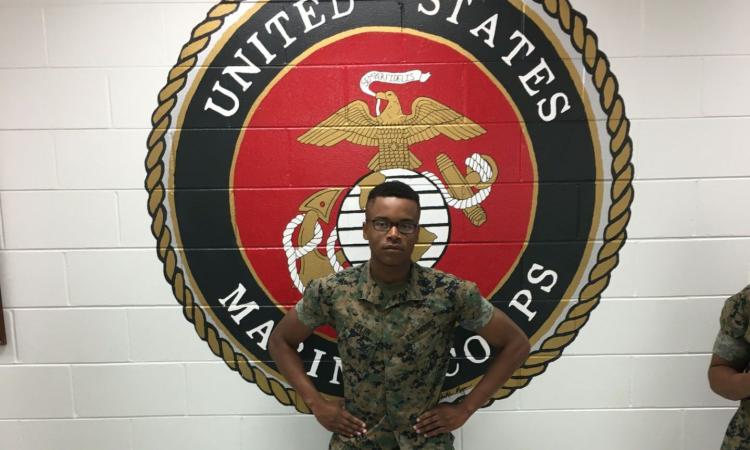
A Marine Corps Veteran’s Pathway to Georgia Tech
Andre Gelin came to Tech to study electrical engineering as a transfer student via a special pathway reserved for veterans.
Georgia Tech Enrollment Management
Andre Gelin came to Tech to study electrical engineering as a transfer student via a special pathway reserved for veterans.
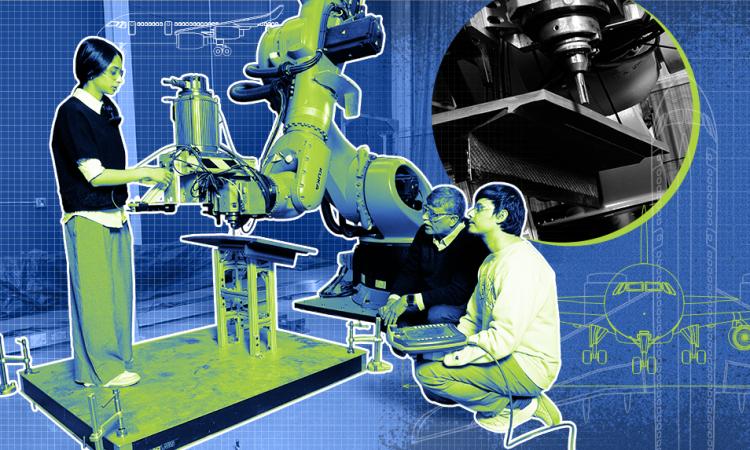
Industry Connections
Collaborating with industry gives companies access to world‑class expertise and new ideas. For students and faculty, it’s a direct line to the challenges defining real‑world engineering.
Collaborating with industry gives companies access to world‑class expertise and new ideas. For students and faculty, it’s a direct line to the challenges defining real‑world engineering.
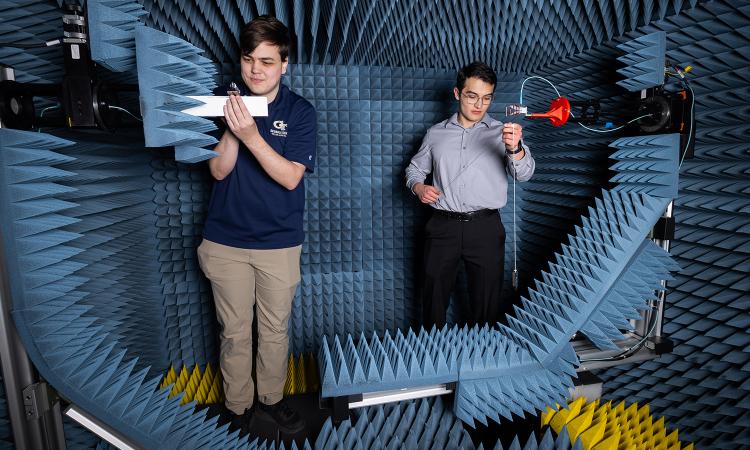
Behind the Lab Doors
With thousands of faculty and student researchers and countless research areas spread across eight schools, you never know what you’ll see when you visit a lab space.
With thousands of faculty and student researchers and countless research areas spread across eight schools, you never know what you’ll see when you visit a lab space.