
Exit Interview
(text and background only visible when logged in)
Wednesday, 6 May 2026
(text and background only visible when logged in)
How much does a person grow in college? How do their plans shift as they gain more experiences and a wider perspective?
Four years ago, members of the new cohort of College of Engineering Dean’s Scholars agreed to help us find out. They spent a few minutes in their first semester on campus sharing their hopes and plans for life. As most of them prepared to graduate this spring, they revisited those thoughts and shared what’s changed in their lives.
As you might expect, they were a little wiser with age — though some found their younger selves had things pretty well under control from the beginning.
(text and background only visible when logged in)
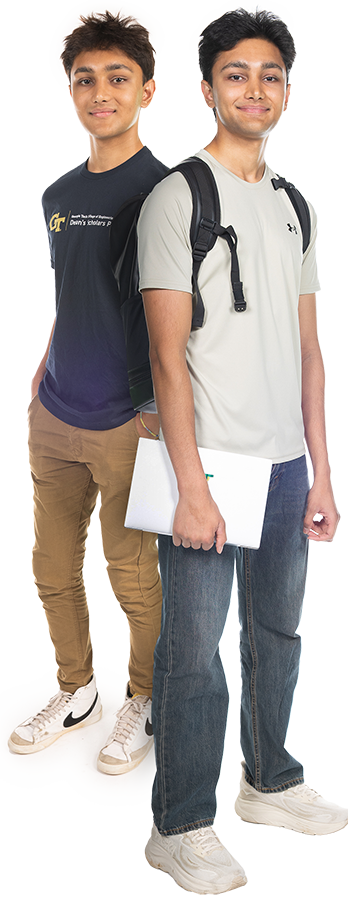
Ghufran Bhatti
Chemical Engineering
Learning to Navigate Doubt
The path Ghufran Bhatti had laid out for himself was clear when he arrived at Georgia Tech. Whether he would be able to follow it felt less certain.
Bhatti chose to study chemical engineering with the goal of pursuing a career in the oil and gas industry. Chemistry always appealed to him, as did the potential to travel and experience more of the world. And he was attracted by the prospects of a stable financial future to help his mother finally retire.
But he worried. Tech’s reputation for challenging students was well-known — and he’d known people who struggled in engineering. That’s why, when we met in his first year, he left himself this message: “I would tell myself to not be so uncertain and doubt yourself so much. As of right now, I'm not sure if I can make it. But if I do make it, I would definitely tell myself to not worry as much.”
Four years later, message received. And honored.
Bhatti is finishing his chemical and biomolecular engineering degree and has a job lined up at ExxonMobil in Baton Rouge, Louisiana. After a few years, he might have the opportunity to work abroad for the company.
Pretty much exactly as he planned it. The difference, he says, is that he sees things as less black-and-white now — not just success or failure but shades of gray. Uncertainty isn’t gone; he’s learned how to carry it.
I think I’ve come to accept that in life you're going to be uncertain. You can't really know what's going to happen tomorrow. It's more so just learning to live with that and trying your best every single day. Sometimes you'll still have a bad tomorrow. You just have to move through that and push through.
Bhatti also says he’s learned to see himself more clearly, to appreciate the layers of his identity — a proud half-Pakistani, half-Indian chemical engineer who values the sacrifices of previous generations that have given him a world of opportunities. Someone who enjoys playing basketball and is trying to — but not making much progress at — learning to play piano. An optimist who worries less now about trying hard and failing.
“I'm not going to go to the NBA, even if I start training for basketball 10 hours a day. But for more realistic goals, I tend to think if I try my best, I can achieve it,” he says. “Back then, I didn't think that way.
(text and background only visible when logged in)
Antonia Rabisheva
Electrical Engineering
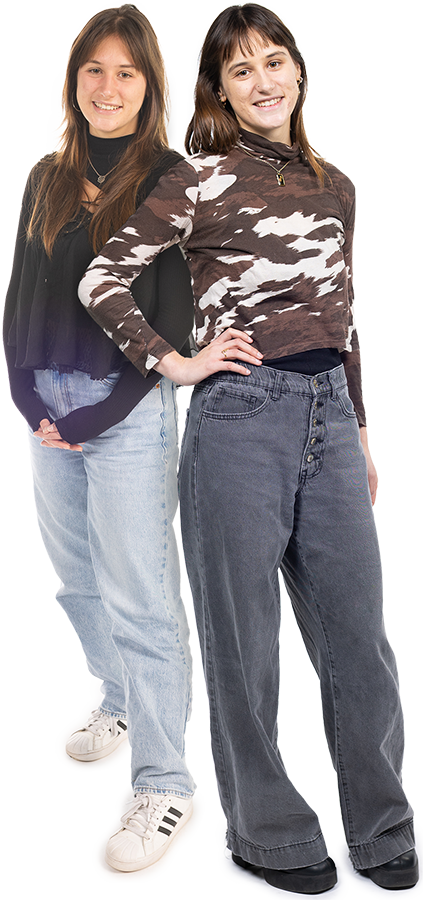
Refining Focus to Find the Harmony
Music and meaning were core to Antonia Rabisheva’s plans as she started her electrical engineering degree at Georgia Tech in 2022. She wasn’t exactly sure where she was headed, but she hoped to blend engineering and music technology into a career.
She felt a bit intimidated by her major. But a mentor in high school convinced her she had what it took to succeed in electrical engineering and at Tech.
He told me, ‘Don't underestimate yourself. You can really do great things if you pursue it.’ So I took his word and decided to take the risk.
After arriving on campus, Rabisheva wasn’t sure if she’d made the right choice. She struggled early on and felt out of place. In part, she attributes that to something she acknowledged back in 2022 — she has a hard time choosing just one thing to pursue. She wanted to try everything and explore new interests.
She says that’s still true now. But she’s learned to focus, and along the way found her place in electrical engineering.
“It's not about holding onto everything that I identify with; it’s more that if I wanted to progress forward with my degree and become the engineer I always wanted to be, I would have to let go of a few things for now,” she says.
“That comes with advantages. It also comes with consequences. But I don't think there was a better decision for me to have made than to invest in my engineering degree here at Tech.”
Some of the things Rabisheva invested in reflected what she’d imagined as a first-year student. She became a master peer instructor in benchtop electronics at the Hive makerspace. She writes music and performs regularly with a band. She also ended up in unexpected places, including on the Georgia Tech Solar Racing team. The younger version of herself would never have joined an engineering competition team. The older Rabisheva became a leader on the team and says it was very rewarding.
Rabisheva will spend the next year in back-to-back internships working on analog hardware design and radio frequency (RF) products. Then she’ll wrap up her degree and look for work in the RF industry.
Back in 2022, Rabisheva said she felt fresh, with a world of options and the opportunity to develop momentum anywhere she chose. And now?
“She was very fresh,” Rabisheva says. “I’m still very fresh. I can still do so much and have lots of choices available to me.”
(text and background only visible when logged in)
Rivash Deepnarain
Mechanical Engineering
An Identity Centered on Helping
Rivash Deepnarain remembers walking through car shows as a kid and being fascinated by how they worked. By high school, he was deep into Formula 1 racing, even starting a YouTube channel to talk about races and the engineering behind the cars. So he knew what he wanted to do: study mechanical engineering and work in the automotive industry. Maybe even design F1 cars one day.
With graduation nearing, he still loves F1, but he’s less focused on becoming an automotive engineer. His college experiences have widened his perspective on the ways he can have a fulfilling career.
Deepnarain has been a co-op student at Delta Air Lines and developed a passion along the way for the aviation industry. He works on airplane cabin interiors and sees how that can allow him to bring creativity and engineering skills together to make a difference for passengers.
That idea of having an impact was a big part of how Deepnnarain saw himself four years ago. And it still is.
“Wherever I end up, in whatever career, one of my major goals is to make a difference,” he says, adding: “A strong part of my identity, I think, is always helping others. I try to help people wherever I go. I think that helps define who I am.”
In high school, and now in college, he has devoted significant time to tutoring other students. Lately he’s been working to digitize that passion, developing a platform where students who excelled in a class could create a series of tutoring lessons to help people who might struggle in future semesters.
Once I get through a class, I know the secrets on how to succeed, and I can make it a lot easier for another student who's just starting it.
It’s a sentiment that he’d apply to himself if he could go back and share a bit of secret sauce with his younger self. It’s certainly a lesson he expects to carry forward wherever he lands in his career.
“One of the major things I've learned throughout these four years at Tech is to detach yourself from the outcome,” Deepnarain says. “After taking some hard classes, I’ve realized that if you focus on putting in the work to learn the material and detach yourself from what grade you’re going to get, the results will come. I would’ve stressed a lot less if I knew that earlier.”
(text and background only visible when logged in)
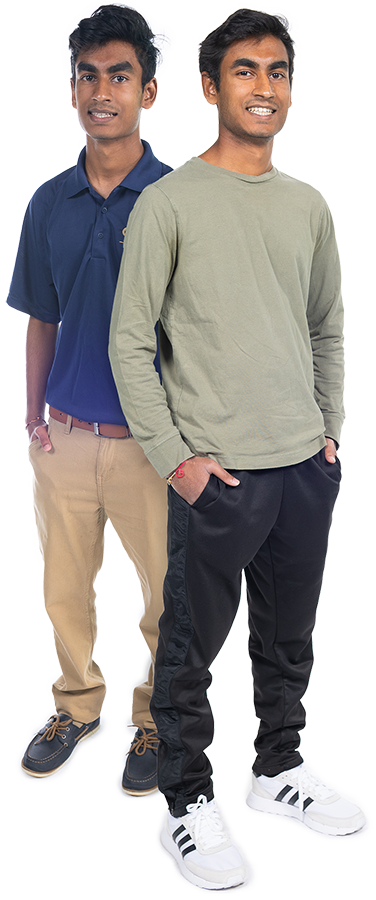
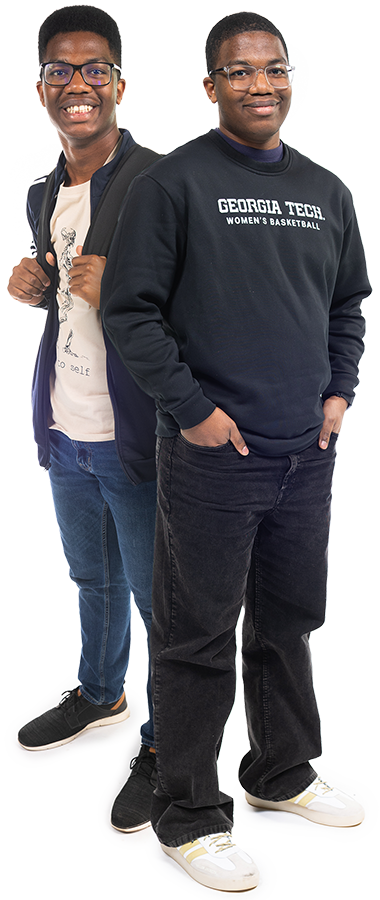
Carson Veal
Industrial Engineering
Growing Through Challenges
Looking back, Carson Veal suspects he might’ve been a little shell-shocked when he first sat down with us. He didn’t really talk about it, but he recalls now that he was “going through it academically.” Those struggles were compounded by the social adjustment to college. He was trying to find his place and his people, and he remembers a lot of growing pains.
Then he started to get into more industrial engineering classes and enjoy what he was learning.
“I was doing better and then I really start to find my community, both in my church and throughout Georgia Tech's campus,” Veal said. “I feel like Carson back then would be very happy with the friends I've made and all the things I've been able to experience.”
Veal came to Tech envisioning a career working for professional sports teams managing their travel and operations. He’s been able to pursue that passion for the last two years as a student manager for Tech’s women’s basketball team. It’s a job he loves — but it’s also shown him the long hours, demanding schedules, and all-consuming lifestyle required in those roles,
Veal realized he has a different vision for his life. Plus, an internship at Boeing clicked with everything he loves about industrial engineering and helped him land a job at the company working on their internal supply chain team.
Boeing’s home outside of Seattle is a very different environment from Atlanta or his Oklahoma hometown, Veal says, and he wants to lean into the Pacific Northwest’s outdoorsy lifestyle. He wants to find a good church and learn more about music, an interest he’s developed in college.
Work is important, but so is everything outside of that. I want to build a really strong community where I’m living and find a good balance.
Balance. Perspective. Resilience. Veal says he knew Tech would challenge him. Not always in ways he expected. But always in ways that have helped him grow.
“There are going to be more challenges throughout life, so getting to experience hard things now has prepared me for what's to come,” he says. “It’s made me more excited for the future than scared.”
(text and background only visible when logged in)
Priscilla Pierre
Civil Engineering
Staying the Course
The questions on Priscilla Pierre’s mind four years ago weren’t about direction so much as validation. Would she succeed academically? What kinds of relationships would she form? Would she still love civil engineering at the end of her Tech career?
Pierre arrived on campus laser focused on becoming a structural engineer specializing in earthquake resilience. As a self-described Army brat who’d already lived all over the world, she wanted to find work that would allow her to travel and experience new places.
She felt comfortable academically in the early days. Courses were manageable and she was doing well. Then she moved deeper into her core engineering classes. The workload, complexity, and rigor set in quickly.
“I wish I would have known how hard it was going to be,” she says now.
My freshman year, it was a lot easier than it became. But it was definitely worth it. I'm glad I stayed on the path, because I still love it to this day.
So that’s the answer to one of those questions: Yes, she still loves civil engineering.
The answers to the others came in different ways than she might have expected.
She says she realizes now that a perfect GPA isn’t the measure of academic success she once thought it was. Instead, she can step back and look at where she stands four years later: already finished with her civil engineering bachelor’s and about to complete her master’s degree. Then she’s going to work for the U.S. Navy’s Naval Facilities Engineering Systems Command.
It wasn’t her plan to complete two degrees so quickly but slowing down never occurred to her.
It’s part of her evolution — persisting, continuing to learn, and connecting with people. Which answers her other key question, Pierre says: “I'm much more of a people person than I was back then. I've had a lot of opportunities to make connections.”
In particular, she values her experiences as a resident assistant, where she’s been able to mentor younger students and build relationships with them.
For Pierre, college didn’t result in dramatic shifts, but a sustained throughline. She has the same purpose now as she did when she arrived on campus, she says.
“I'm really interested in making safe places for people to work, live, and play.”

(text and background only visible when logged in)
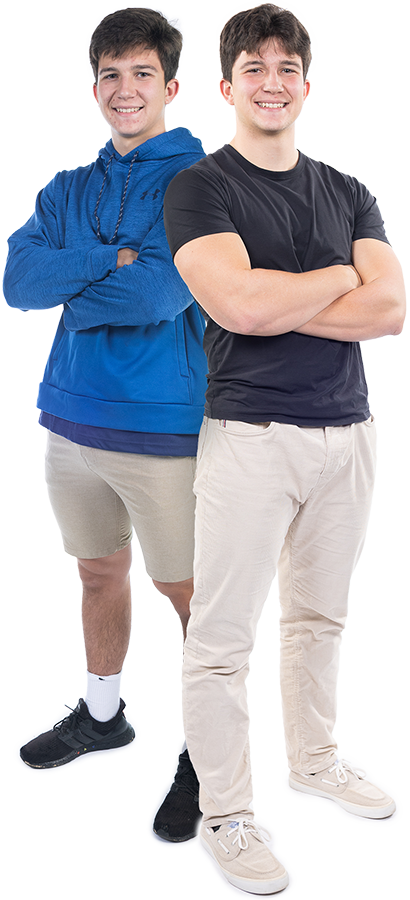
Lukas Anisansel
Industrial Engineering
Open to the Possibilities
Lukas Anisansel wasn’t so interested in laying out a plan for his whole life in his early days of college. Sure, he was thinking about building a fulfilling life and — after growing up on Long Island — settling somewhere warmer. Most of his focus, though, centered on exploring all the facets of industrial engineering and settling on a direction for himself. Could be data analytics, he said, or supply chain engineering. Or something else.
“Honestly, I'm not sure what kind of job I want to pursue yet,” he said four years ago.
That's part of why I picked industrial engineering, because there are multiple paths. Once I start taking industrial engineering-specific classes, that's when I'll figure out what I want to do.
It turns out, he seems to have had a least an inkling of where his interests might lie. He’ll start work this summer as a data analyst at Siemens just north of Atlanta in Alpharetta. He enjoyed similar work as an intern and has worked part-time with the company all year.
Staying in the South means he’s also checking the box of a warmer climate than his native New York.
Originally, Anisansel thought about college primarily in terms of academics and finding a career path. His view shifted as he learned the value of extracurriculars. He’s leading a team within the Dean’s Scholars Program that’s building a roadmap for future scholars to help them navigate Tech. He also has found fulfillment working on a senior design project with an Atlanta nonprofit.
Anisansel says Tech has brought him out of his shell, too. He’s more outgoing, more comfortable in unfamiliar places, and more confident engaging with new people.
Four years ago, the question on his mind wasn’t about any of that, though. It was simpler, and perhaps more profound: how happy are you?
“I'm definitely happy with everything I've done and all the experiences I've had,” Anisansel says. “I wouldn't trade them for anything. Georgia Tech definitely helped shape me into the young man that I am becoming now.”
(text and background only visible when logged in)
Related Content
Six Years After It Began, Dean’s Scholars Program Eclipses 100 Endowed Scholarships
The community-based program includes tuition help and professional and leadership development, mentoring, academic advising, and mental health support for engineering students.
Dean's Scholars Program
The College of Engineering Dean’s Scholars Program supports promising, highly qualified undergraduate students to create multidimensional engineers.